
- Template item
Having the right team structure is fundamental to a marketing agency’s ability to achieve its goals, satisfy clients, and navigate ever-changing market conditions. When the team aligns seamlessly with the agency's objectives and the needs of its clients, collaboration flows effortlessly and the agency has an opportunity to grow.
Conversely, a misaligned team structure can create communication barriers, blur responsibilities, and hinder scalability, all of which undermine the agency's success. In this guide, we'll explore practical strategies to design and implement an effective agency structure that not only supports your current operations but also scales with your agency’s ambitions.
What is a Marketing Agency Team Structure?
A marketing agency structure outlines how personnel are organized, roles are defined, and workflows are managed to deliver client results efficiently. This traditional marketing agency structure typically includes specialized roles for functions like creative, account management, marketing strategy, and analytics, each with clear responsibilities. By organizing teams in a definite structure, marketing agencies ensure smooth project progression from start to finish, with everyone knowing their specific roles and how they contribute to the overall objectives.
A well-structured team promotes seamless collaboration, improves campaign efficiency, and boosts return on investment (ROI) for clients. For example, a Strategist can create detailed plans that the Creative Lead executes, while the Data Analyst tracks performance and provides insights for improvement. This clear division of labor accelerates project timelines and ensures high-quality outcomes that satisfy clients.
In contrast, a poor agency structure can lead to duplicated efforts, unclear accountability, and slow delivery. When roles overlap or aren’t well-defined, resources are wasted, and important tasks can be overlooked, which delays projects and damages client relationships. Inefficient workflows also make it harder for the agency to scale and take on more clients.
By establishing the right marketing agency structure, you can avoid these issues and create a productive environment where both your creative team and clients thrive.
Types of team structures
Choosing the right team structure is crucial for aligning your agency’s marketing operations with its goals and the needs of your clients. Different structures offer various advantages and can significantly impact how your team collaborates and delivers results. Here are the main types of agency structures:
1. Flat teams
In a flat structure, there are few or no hierarchical levels, which allows team members to take on multiple roles and collaborate closely. The cross-functional nature of flat teams means that creative, strategic, and analytical tasks are often handled by the same individuals, facilitating a holistic approach to client campaigns.
This approach promotes a culture of open communication and swift decision-making, as everyone has a clear understanding of their responsibilities and can contribute directly to various aspects of a project. . This structure is especially beneficial for small agencies that need to pivot quickly and handle a diverse range of client needs without the constraints of rigid departmental boundaries.
2. Specialized teams
Specialized teams organize staff into distinct departments based on specific functions such as SEO, PPC, content creation, and design. Each department operates independently with minimal overlap, allowing team members to develop deep expertise in their respective areas.
This structure is well-suited for agencies that handle large volumes of work in particular niches, as it ensures that each function is managed by specialists who can deliver high-quality results efficiently.
By having clear departmental boundaries, agencies can streamline workflows and optimize processes within each area of expertise. However, it’s important to maintain strong inter-departmental communication and cross functional collaboration when working on integrated campaigns for clients.
3. POD-based teams
POD stands for “Product-Oriented Delivery” and a pod-based team (or pod-structure) consist of cross-functional groups tailored to specific client accounts or campaigns.
Each pod typically includes a Strategist, Data Analyst, Creative Lead, and Account Manager, working together to deliver comprehensive solutions for their assigned projects. This pod structure promotes a high level of collaboration and accountability, as each pod is responsible for the entire lifecycle of a client’s campaign from planning to execution and analysis.
By aligning team members around specific clients or campaigns, pod-based structures improve focus and ensure that all necessary skills are available within each pod to meet client needs effectively. This approach also promotes better communication and faster problem-solving, as team members are closely integrated and share common goals within their pods.
4. Matrix structures
Matrix structures are best suited for large, enterprise-level agencies that manage multiple clients across various regions simultaneously. This approach combines elements of both functional and pod-based structures, allowing team members to report to both a functional manager and a project/client manager.
For example, a designer might work within the creative department while also being assigned to specific client pods as needed. This dual-reporting system enables greater flexibility and resource sharing across different projects and regions. This ensures that expertise is used efficiently and that the agency can scale effectively.
However, matrix structures can also introduce complexity in management and communication. That’s why they require clear protocols and strong leadership to prevent conflicts and ensure that team members remain aligned with both their functional and project responsibilities.
Key Roles in a Marketing Agency Team

To build a successful marketing agency, it's essential to have the right people in the right roles. Each position plays a critical part in ensuring campaigns are effective, clients are satisfied, and the agency runs smoothly. Let’s explore the key roles you need to consider when structuring your marketing agency.
1. Account Manager
The Account Manager serves as the primary liaison between the agency and its clients. They ensure that client expectations are met and that projects are delivered on time and within budget. You should hire an Account Manager once your agency begins handling multiple clients simultaneously, and requires dedicated oversight for each relationship.
Responsibilities:
- Serve as the main point of contact for clients;
- Understand and manage client expectations and objectives;
- Coordinate internal teams to ensure project milestones are met;
- Provide regular updates and reports to clients;
- Address and resolve any client concerns or issues;
- Develop and manages client relationships to encourage repeat business;
- Identify opportunities for upselling additional services.
2. Strategist
The Strategist aligns campaign goals with the client’s broader business objectives, ensuring that marketing efforts are targeted and effective. Bring on a Strategist to the team when your campaigns require in-depth planning and alignment with long-term business goals. This typically happens as your client base grows.
Responsibilities:
- Develop comprehensive marketing strategies based on client objectives;
- Conduct market research and competitive analysis;
- Define target audiences and key messaging;
- Set measurable campaign goals and key performance indicators (KPIs);
- Collaborate with other teams to ensure the execution of strategies;
- Monitor and adjust strategies based on performance data.
3. Creative Lead/Designer
The Creative Lead (or Designer) focuses on the visual aspects of campaigns, making sure that all creative materials effectively communicate the intended message. Add a Creative Lead to your team when your campaigns require high-quality visual content, such as graphic design, video production, or branding work.
Responsibilities:
- Develop creative concepts and visual designs for campaigns;
- Oversee the creation of graphics, videos, and other visual content;
- Ensure all creative work aligns with client branding and campaign goals;
- Collaborate with the Content Specialist and Strategist to integrate visuals seamlessly;
- Manage the creative workflow and deadlines;
- Provide feedback and direction to junior designers or freelancers;
- Stay updated on design trends and incorporate them into specific projects.
Read: How to Hire a Fractional Creative Director in 2025
4. Content Specialist
The Content Specialist creates and manages the messaging and content across various platforms, ensuring consistency and engagement. Bring in a Content Specialist as your agency scales and the demand for diverse content types (blogs, social media, email) increases.
Responsibilities:
- Develop and execute content strategies aligned with client goals;
- Write and edit content for websites, blogs, social media, and other channels;
- Ensure all content is on-brand and consistent in tone and style;
- Collaborate with the Designer and Strategist to create cohesive marketing campaigns;
- Optimize content for SEO and audience engagement;
- Manage content calendars and deadlines;
- Analyze content performance and adjust strategies accordingly.
Read: What Does a Content Marketing Manager Actually Do?
5. Performance Marketer
The Performance Marketer manages paid advertising campaigns across search and social media management platforms to drive measurable results, such as leads, sales, or website traffic. You should hire a Performance Marketer when your agency starts handling significant paid media budgets and requires specialized expertise to maximize ROI.
Responsibilities:
- Plan, execute, and manage paid advertising campaigns across platforms (e.g., Google Ads, Facebook Ads);
- Conduct keyword research and audience targeting;
- Monitor and optimize campaign performance to achieve KPIs;
- A/B test ad creatives and landing pages to improve effectiveness;
- Manage budgets and ensure cost-effective ad spend;
- Generate performance reports and provide insights for improvement;
- Stay updated on paid media trends and platform updates.
Read: How to Structure a High-Performing Paid Search Marketing Team in 2025
6. SEO Specialist
The SEO Specialist optimizes client websites and content to improve organic search rankings and increase visibility. Bring on an SEO Specialist when your clients require sustained organic growth and your agency handles multiple SEO-focused projects.
Responsibilities:
- Conduct keyword research and competitive analysis;
- Optimize website structure, content, and metadata for search engines;
- Develop and implement link-building strategies;
- Perform technical SEO audits and address issues;
- Monitor and analyze SEO performance using tools like Google Analytics and Search Console;
- Stay updated on the latest search engine optimization trends and algorithm changes;
- Collaborate with the content team to ensure SEO best practices.
Read: 15 SEO Skills to Look for When Hiring an Expert in 2025
7. Data Analyst
The Data Analyst tracks and interprets campaign performance data, providing actionable insights to optimize strategies and improve results. This role becomes important when your campaigns generate significant data that requires specialized analysis to inform decision-making and marketing strategy adjustments.
Responsibilities:
- Collect and analyze data from various marketing channels;
- Develop dashboards and reports to track key performance metrics;
- Identify trends, patterns, and insights to inform campaign strategies;
- Provide recommendations for optimization based on data findings;
- Collaborate with other teams to implement data-driven improvements;
- Ensure data accuracy and integrity across all reporting tools;
- Be proficient in data analysis tools and methodologies.
Responsibility Assignment Matrix (RACI)
A RACI matrix is a tool used to clarify roles and responsibilities in a project management team by outlining who is Responsible, Accountable, Consulted, and Informed for each task. It helps prevent confusion, ensures accountability, and streamlines communication within the team.
- R (Responsible): The person who does the work to achieve the task.
- A (Accountable): The person ultimately answerable for the task's completion.
- C (Consulted): Individuals who provide input and expertise.
- I (Informed): Those who are kept updated on progress and outcomes.
Here’s a sample RACI for a marketing campaign in an agency:
Using a RACI matrix like this one ensures that every team member understands their role in each task, which reduces overlaps and gaps, and increases overall campaign efficiency and success.
How to Build a Marketing Agency Team Structure
Creating an effective team structure is a strategic process that requires careful planning and consideration of your agency’s unique goals and capabilities. Let’s walk through the essential steps to design an agency structure that aligns with your agency’s vision.
Step 1: Define your agency’s strategic goals
Start by clearly outlining what your agency aims to achieve. Determine whether your agency will specialize in creative branding, performance marketing, integrated campaigns, or a combination of these areas. For example, if your focus is on creative branding, you might prioritize roles like Creative Lead and Content Specialist. If performance marketing is your main area, roles like Performance Marketer and Data Analyst become crucial.
Then, establish where you see your agency in the next few years, whether it’s expanding into new markets, increasing your client base, or enhancing your service offerings. The goal is to build a team comprising roles that will contribute to achieving your long-term vision.
Step 2: Assess current resources and gaps
Evaluate your existing team and resources to identify what you have and what you need to achieve your strategic goals. First, determine which skills are currently lacking in your team that are essential for your agency’s focus. For instance, a creative-focused agency might need additional graphic designers or copywriters, while a performance marketing agency might require more data analysts or PPC specialists.
Then, analyze your current processes to find bottlenecks or areas where you can optimize your workflow(s). Inefficient workflows can slow down project delivery and reduce overall productivity. Also, assess whether any team members are overloaded with tasks that can lead to burnout and decreased performance.
Identifying these areas allows you to redistribute workloads or hire additional staff as needed.
Step 3: Align roles with service offerings
Once you understand your strategic goals and have assessed your current resources, it’s time to align specific roles with your service offerings. So, if your agency emphasizes SEO, prioritize hiring an SEO Specialist. For a creative-driven agency, a Creative Lead should be a top priority. Ensure that each role directly supports your primary service offerings and increases your ability to deliver specialized and high-quality marketing services to clients.
Also, determine whether you’ll hire generalists or specialists. Generalists are suitable for smaller (or startup) agencies or those that require flexibility. They can handle multiple roles, which is beneficial when resources are limited or when specific projects require diverse skills.
Specialists, on the other hand, are critical for larger agencies or those focusing on specific areas. They bring deep expertise, which is essential for delivering exceptional results in their particular domain. Specialists become necessary when your agency scales, handles complex projects, or aims to offer highly specialized services to clients.
Step 4: Establish cross-functional workflows
Creating efficient workflows helps your team collaborate smoothly and ensures projects move forward without unnecessary delays. Here are some steps to take to improve your workflows:
- Develop standardized templates for project briefs to ensure all necessary information is captured and communicated clearly from the start.
- Implement structured review processes, including regular feedback and revisions, to maintain quality and consistency.
- Use platforms like Slack or Microsoft Teams to communicate in real time and to keep everyone connected.
- Tools like Asana, Trello, or Monday.com can help you manage tasks, deadlines, and project progress efficiently.
- Use tools like Google Workspace or Dropbox to help the team share and collaborate on documents and creative assets easily.
- Schedule consistent check-ins and team meetings to make sure everyone is on the same page and to address any issues promptly.
- Maintain comprehensive documentation for workflows, processes, and role responsibilities to provide clarity and consistency.
- Allow room for adjustments and improvements in your workflows to adapt to changing project needs and team dynamics.
Adapting Team Structures to Different Business Contexts
Every marketing agency operates within a unique business context, which influences how its structure should be organized for optimal performance. Here’s how to structure your team according to different business contexts:
1. Startups
In its early stages, a marketing agency operates with limited resources and needs to move quickly to establish its presence in the market. Team members in a startup marketing agency are typically generalists, handling multiple roles and adapting to various tasks as needed. This versatility allows the agency to pivot strategies swiftly in response to market changes or client demands.
Employees likely take on diverse responsibilities, from content creation and creative design to client management and data analysis. This approach maximizes resource utilization and promotes a collaborative and dynamic work environment where everyone contributes to different aspects of the business.
2. Scaling agencies
As your marketing agency begins to scale, the demands on the team become more complex. So, you have to move from hiring generalists to bringing on specialists.
These specialists include dedicated SEO Specialists, Content Managers, and Performance Marketers. This specialization allows individual team members to develop deeper expertise in their respective areas, which lead to higher quality work and more efficient project execution.
With an expanding team, establishing clear processes for task handoffs and accountability becomes essential. Implementing standardized workflows ensures that projects move smoothly between different departments and that each team member understands their responsibilities.
3. Established agencies
For established marketing agencies with a substantial client base and a well-defined market presence, deep specialization and operational efficiency is necessary. These agencies often need highly specialized teams that focus on specific aspects of marketing, such as advanced analytics, strategic planning, or creative innovation, so they can deliver top-tier services and stay competitive in niche markets.
If your agency manages clients across different industries who operate in different locations, you may need to create regional teams that understand local market dynamics or develop dedicated units for different industries. You may also need to Invest in a robust infrastructure, including advanced project management systems, comprehensive training programs, and strong leadership to a maintain high standard of service and operational excellence.
4. Industry-Specific Needs
Different industries have unique requirements that can significantly impact how a marketing agency structures its team.
If you operate in regulated industries like finance or healthcare, you’ll need team members who are well-versed in industry-specific regulations and compliance standards. You’ll also need meticulous documentation and review processes to ensure that all your marketing materials and digital marketing campaigns adhere to regulatory guidelines, as well as secure communication channels to protect sensitive client information.
If your agency serves high-volume industries like eCommerce, then you’ll need a highly efficient and scalable structure to handle large volumes of work without compromising quality. This often involves automating repetitive tasks and optimizing workflows to manage the demands effectively. Depending on your clients’ needs, you may need specialized roles such as Inventory Management Specialists, Conversion Rate Optimization (CRO) Experts, and Customer Experience Designers.
If you operate in creative-driven industries, you’ll need to hire talented creatives who can produce cutting-edge designs and compelling content.
Examples of Effective Marketing Agency Team Structures
Understanding how different team structures operate in real-world scenarios can provide valuable insights into building an ideal marketing agency structure. Let’s explore some practical examples of marketing agency structures:
Example 1: Startup Structure
Startup agencies thrive with a flat team structure where generalists wear multiple hats. In addition to this being cost-effective, a flat team structure also helps a new agency stay flexible and responsive to client needs.
In this structure, team members typically take on broad responsibilities, covering various aspects of the business. For instance, an Account Manager in a startup might not only handle client communications but also assist with project management and strategy development. This dual role ensures that client expectations are managed effectively while contributing to the overall strategic direction of campaigns.
Here’s how a flat organizational structure might look:
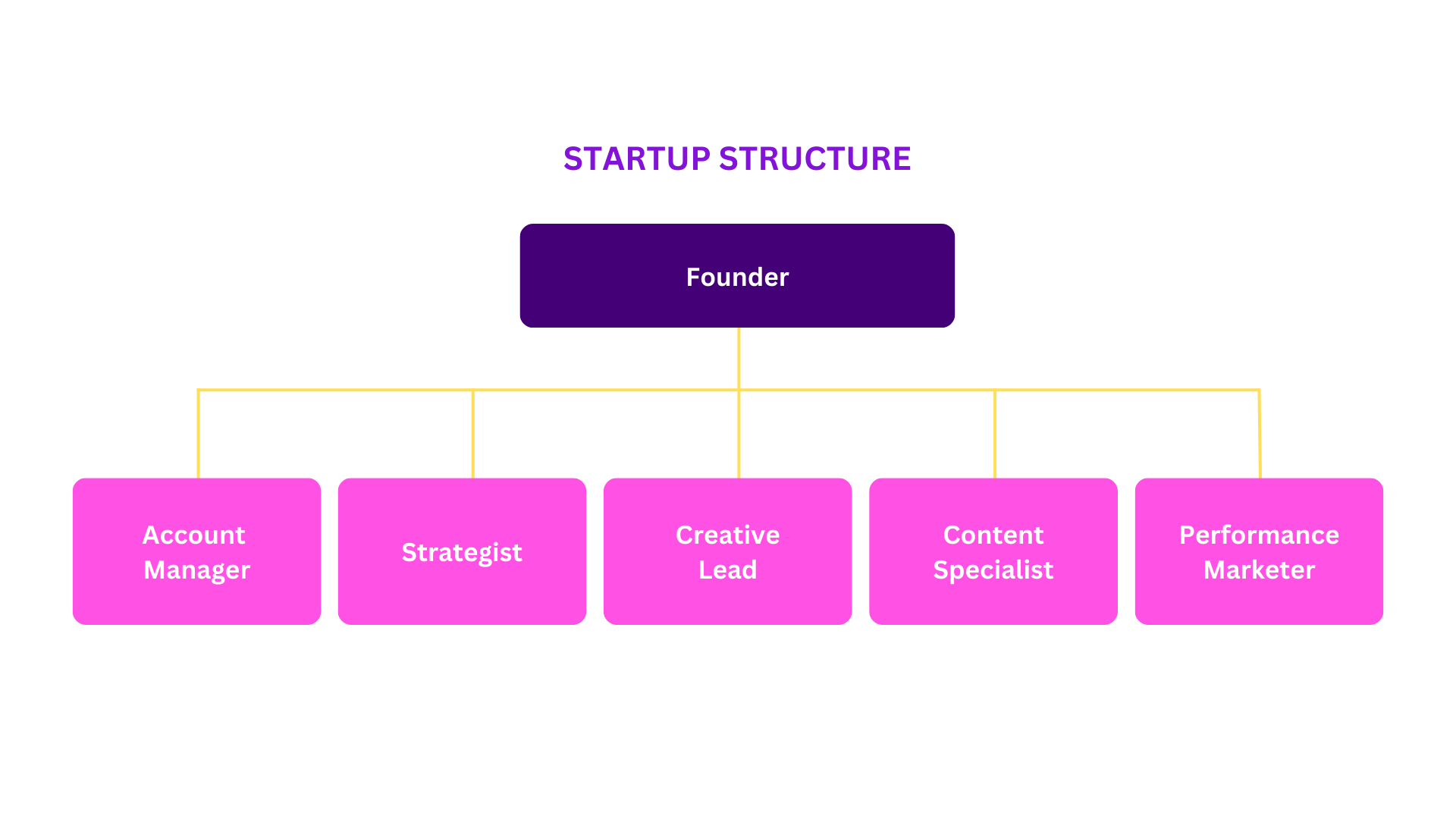
- Founder/CEO
- Account Manager
- Strategist
- Creative Lead/Designer
- Content Specialist
- Performance Marketer
- Data Analyst (shared)
Example 2: Scaling Agency Structure
As your marketing agency grows, its structure should evolve to accommodate increased complexity and client demands. This requires transitioning from a generalist approach to a specialized one, which allows for deeper expertise and greater efficiency.
To keep your agency flexible and scalable without the overhead of a large permanent staff., complement your core team with freelancers and contractors. This hybrid model ensures that you’re able to handle a diverse range of projects without a reduction in service quality.
Here’s a sample hybrid marketing agency org chart:
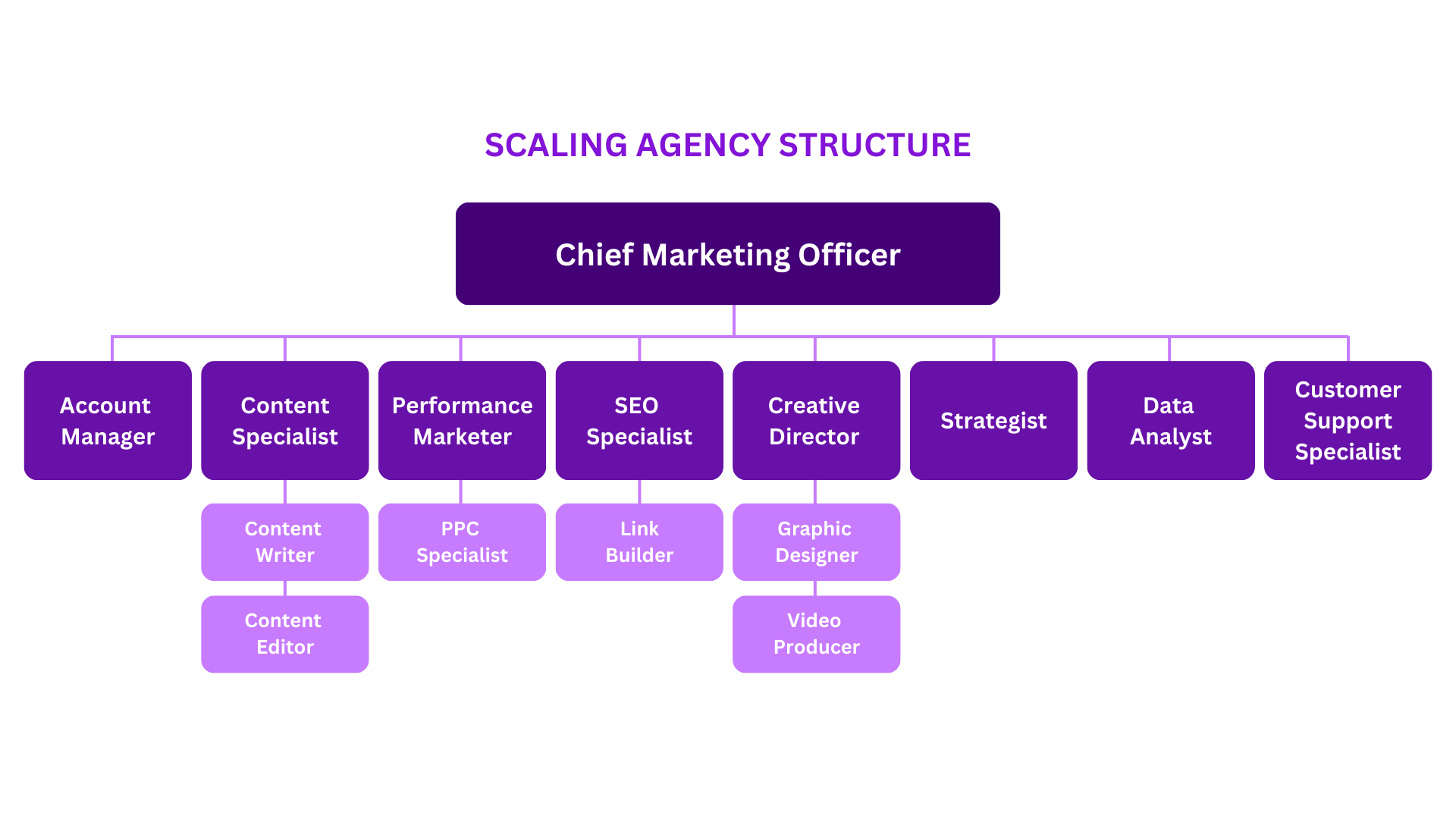
- Chief Marketing Officer (CMO)
- Director of Operations
- Account Manager
- Content Specialist
- Content Writer(s) [freelancer]
- Content Editor(s) [freelancer]
- Performance Marketer
- PPC Specialist(s) [freelancer]
- SEO Specialist(s)
- Link builder(s) [freelancer]
- Creative Director
- Creative Lead/Designer
- Graphic Designer(s) [freelancer]
- Video Producer(s) [freelancer]
- Creative Lead/Designer
- Strategist(s)
- Data Analyst(s)
- Customer Support Specialist(s)
- Director of Operations
Example 3: Enterprise Agency Structure
As your marketing agency reaches the enterprise level, the structure becomes more intricate to handle the increased scale, diverse client base, and complex projects. At this stage, you need to prioritize deep specialization to deliver high-quality, tailored services across various regions and services.
This complexity is managed through a matrix organizational structure, which allows for both regional and service-level pods to operate efficiently. Freelancers and contractors also play a crucial role in providing additional expertise and flexibility.
Here’s a sample enterprise agency structure, showing department heads and other team members:
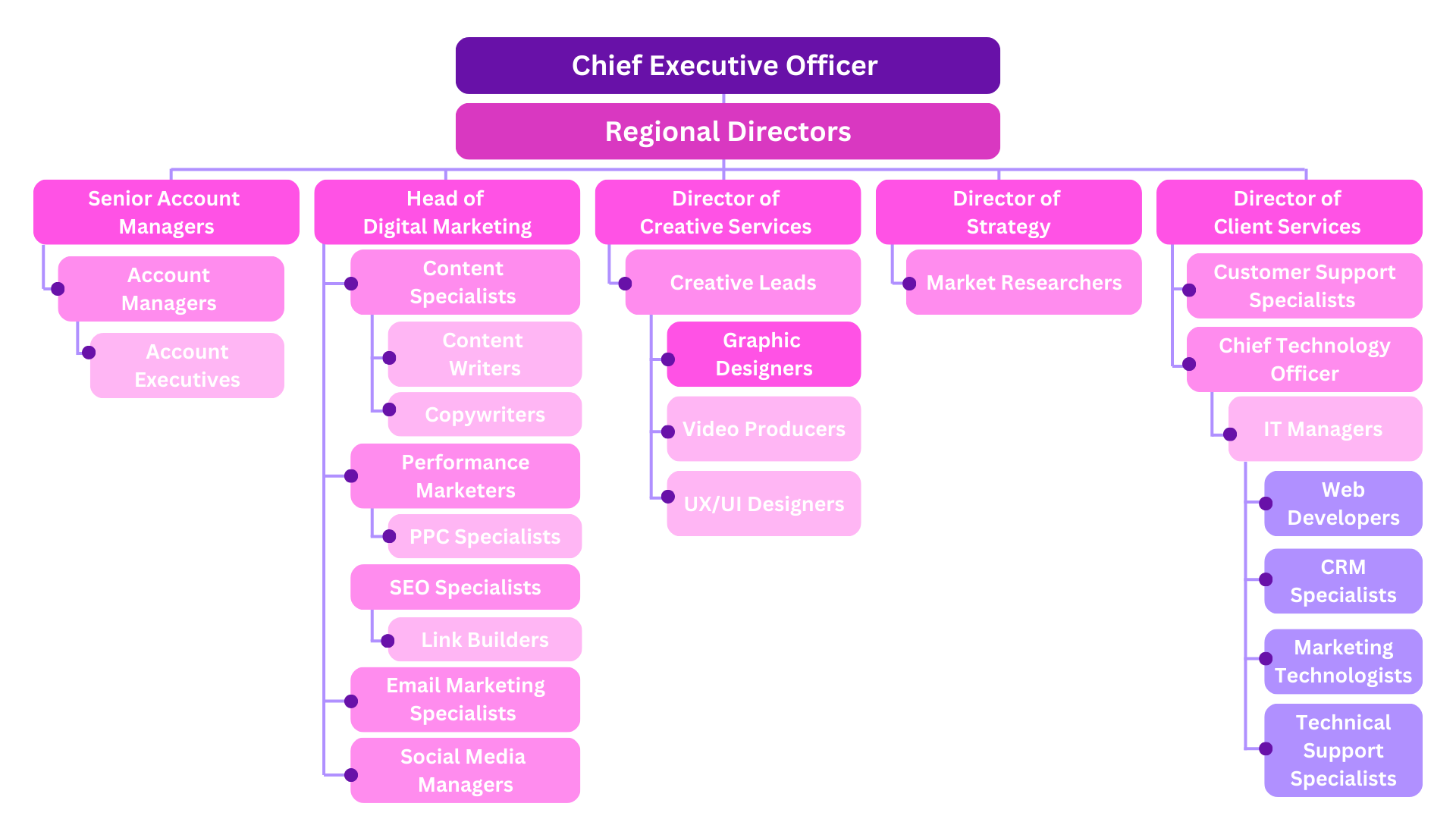
- Chief Executive Officer
- Regional Directors [North America, Europe, Asia-Pacific, etc.]
- Senior Account Managers
- Account Managers
- Account Executives
- Account Managers
- Head of Digital Marketing
- Content Specialists
- Content Writers [freelancers]
- Content Editors [freelancers]
- Copywriters [freelancers]
- Performance Marketers
- PPC Specialists [freelancers]
- SEO Specialists
- Link Builders [freelancers]
- Email Marketing Specialists
- Social Media Managers
- Content Specialists
- Director of Creative Services
- Creative Leads/Designers
- Graphic Designers [freelancers]
- Video Producers/Editors [freelancers]
- UX/UI Designers [freelancers]
- Creative Leads/Designers
- Director of Strategy
- Strategists
- Market Researchers [freelancers]
- Data Analysts
- Strategists
- Director of Client Services
- Customer Support Specialists
- Chief Technology Officer/IT Director
- IT Managers
- Web Developers
- CRM Specialists
- Marketing Technologists
- Technical Support Specialists
- IT Managers
- Senior Account Managers
- Regional Directors [North America, Europe, Asia-Pacific, etc.]
When to Hire In-House vs. Use On-Demand Talent
When deciding whether to hire in-house team members or leverage on-demand talent, you should understand the right circumstances for each approach. This ensures that you maintain the right balance between stability and adaptability, which ultimately supports your agency’s growth and improves client satisfaction.
When to hire full-time team members
Hiring full-time employees is ideal if you’re facing long-term, predictable workloads and need to fill critical, recurring roles. Full-time team members provide stability and continuity, and manage your agency’s essential functions.
For example, roles such as Account Managers and SEO Specialists are pivotal to maintaining strong client relationships and optimizing ongoing campaigns. These positions require a deep understanding of your clients’ needs and your agency’s processes, which is best achieved through dedicated, in-house staff.
Full-time employees are also more likely to develop a strong company culture and invest in the agency’s long-term success, which promotes loyalty and a deeper commitment to delivering high-quality results.
When to outsource or use on-demand talent
Outsourcing work to freelancers is a strategic choice for managing seasonal projects or accessing specialized expertise that your core team may lack. For instance, during peak periods like Black Friday, your agency might need additional resources to handle the surge in campaign management and execution. Hiring freelancers for these short-term projects allows you to scale your workforce without the long-term commitment and costs associated with full-time hires.
Similarly, when a client requires advanced analytics or niche PPC skills that aren’t part of your existing team’s expertise, bringing in specialized freelancers can fill these gaps efficiently. This approach helps you deliver high-quality, specialized services without overburdening your permanent staff or diverting their focus from core responsibilities.
Read: How You Should Outsource Your Marketing Team (and When) in 2025
Benefits of outsourcing
Outsourcing work to freelancers and contractors offers several advantages, including:
- Cost-efficiency. Outsourcing allows you to avoid the full-time overhead costs associated with hiring permanent employees, such as salaries, benefits, and office space. This is especially beneficial for managing budgets during fluctuating workloads.
- Flexibility. With on-demand talent, you can scale your resources up or down based on project needs. This ensures that you have the right expertise available when you need it.
- Access to specialized skills. Freelancers often possess specialized skills and expertise that may not be available within your existing team. This allows your agency to take on diverse and complex projects without needing to invest in extensive training or new hires.
- Speed. Outsourcing provides faster access to experienced professionals who can hit the ground running. This can significantly reduce the time required to launch and execute client projects.
- Focus on core activities. By delegating specialized or non-core tasks to freelancers, your in-house team can concentrate on strategic initiatives and core activities that drive your agency’s growth and client satisfaction.
- Global talent pool. Outsourcing opens up access to a global pool of talent, allowing you to find the best professionals regardless of their geographic location.
- Creativity and innovation. Bringing in fresh perspectives from external freelancers can stimulate creativity and innovation within your agency. These professionals can introduce new ideas and approaches that enrich your projects and deliver unique value to your clients.
Read: How Storybook Marketing Accelerated Agency Growth with Expert Talent
Build Your Marketing Agency Team with Expert Support
The key to being flexible and scalable is complementing your core team with on-demand talent. By integrating freelance strategists, PPC specialists, or creative leads into your team, you can access specialized skills exactly when you need them, without the long-term commitment of full-time hires. This approach allows your agency to adapt quickly to varying client demands and project requirements.
Imagine filling a critical talent gap in days, not months—without compromising quality. For example, you can hire a freelance PPC Specialist in about a week or two, and then can immediately start working on optimizing your clients' advertising campaigns. Or you can bring in a freelance Creative Lead to infuse fresh ideas and innovative designs into your projects, elevating your creative output and ensuring your campaigns stand out.
Agencies that use on-demand talent often save money and increase efficiency. By tapping into a global pool of skilled professionals, you can improve your service offerings, tackle more complex projects with ease, and maintain a lean, agile team that can scale seamlessly as your business grows.
Read: How Tinuiti Tapped MarketerHire Expert Designers to Scale Creative
Why MarketerHire is the Best Place to Build Your Agency Team Structure

Aligning your marketing agency’s structure with your strategic goals, clients’ needs, and service focus is essential for achieving success and driving growth. Whether you’re a startup, scaling agency, or an established enterprise, having the right structure in place ensures that every team member contributes effectively, improves collaboration, and delivers exceptional results tailored to your clients’ unique requirements.
If you're looking to build your marketing agency team without the arduous, time-consuming process of sifting through countless resumes, conducting numerous interviews, and making multiple offers, look no further than MarketerHire for Agencies. MarketerHire connects you with pre-vetted marketing talent, including both full-time and freelance professionals from top-tier companies like Airbnb and Uber. After sharing your hiring needs with us, we'll aim to match you with the ideal expert in as little as 48 hours.
We offer a two-week free trial for you to test compatibility with the expert. While it’s rare, if it so happens that the first professional we match you with isn’t the perfect fit, we provide a free rematch to ensure you find the right talent for your agency.
With MarketerHire, building a high-performing team has never been easier or more efficient. If you’d like to know how we can help you, schedule a call with us today.
