
- Template item
Think about HubSpot in its early days.
At the time, most marketing software focused on email blasts and pushing messages out as widely as possible. “More outreach equals more results” was the default mindset.
HubSpot took a different approach. They observed how buyers were actually behaving—researching on their own and avoiding hard-sell tactics—and leaned into education. They published playbooks, ran workshops, and built a library of resources that marketers could use without buying anything first.
People didn’t want to be chased. They wanted useful guidance and time to evaluate. HubSpot met that need, and in doing so, the company built trust with a community long before selling became the focus.
That’s what a good brand story does in B2B. It gives your audience a framework for the change they’re already experiencing, and it positions your company as the one helping them make sense of it.
What is a brand story?

A brand story explains why your company exists and what it stands for—not as a slogan, but as a clear narrative that shapes how you show up in the market. It connects your brand's identity, brand's values, and purpose.
The most compelling stories share one principle: the customer sits at the center. As Donald Miller puts it: “Your customer should be the hero of the story, not your brand.” Your role is to support and remove friction so they can reach their goals faster
When your story is built around that idea, your messaging becomes sharper and more intentional. Every campaign, every touchpoint, every piece of content reinforces the same idea: here’s what we believe, and here’s how we help people succeed.
Why a brand story matters
In B2B, it’s easy to default to features and funnels. Most teams do. But the companies that stick in buyers’ minds are the ones with a point of view people can trust.
Effective brand storytelling gives the market a reason to believe you before they compare pricing tables. That's work your important product can’t do alone. Here's how:
- It pre-qualifies your market. You attract buyers who better fit your target buyer persona and hold off on ones who don’t before they hit your pipeline. That protects CAC and keeps sales focused on winnable accounts instead of “maybe” leads.
- It protects your pricing. Your price becomes a reflection of conviction and capability, so your brand doesn’t get dragged into feature comparisons or discount cycles..
- It anchors your roadmap and GTM. Without a compelling narrative, marketing strategy creeps and priorities wobble. A real story forces clarity—who you build for, what you stand against, where you invest—enabling better product decisions.
- It gives customers language to advocate for you. Your best distribution comes from current customers. They can’t repeat a feature map, but they will repeat a belief or a unique selling proposition that makes them look smart for choosing your brand.
Key elements of a strong brand story
Origin/backstory (how it started)
Strong brand stories often trace back to a point when a direction becomes unavoidable. For HubSpot, that moment surfaced while watching small businesses struggle to get traction through constant outreach. The experience shaped a belief that growth could come from being useful and visible when buyers are ready, rather than trying to push into their day.
Values/beliefs (why you do what you do)
Values hold weight when they show up in daily work. HubSpot built credibility by publishing training, templates, and processes openly. Sharing knowledge became part of the culture, and people came to expect that transparency because it appeared in every marketing effort.
Conflict/challenge (the problem you overcame or helped customers overcome)
Good stories hold meaning because something real is at stake. In HubSpot’s case, many teams felt drained by outreach-heavy cycles and wanted a more respectful way to build relationships. That frustration gave the company’s philosophy relevance, and the story resonated because it reflected everyday experiences.
Transformation/outcome (how things changed, what you enable)
A brand story's credibility grows as the company evolves. As HubSpot grew, the company expanded its product line, created a partner network, and continued developing educational programs as the inbound philosophy spread. HubSpot's progress confirmed that educating buyers worked better than push-driven outreach.
Consistency/authenticity (living the story at every touchpoint)
Brand stories resonate when they show up naturally across marketing channels. HubSpot reflected its philosophy in its software, content, training programs, and community efforts. Familiar tone and consistent choices created a brand voice people could recognize without explanation.
How to craft your brand story
After talking with brand marketers in the MarketerHire network, I started seeing a pattern. A few intentional steps go a long way in helping a brand story resonate. Let's take a look.
Step 1: Find out the customer's truth
You’ve probably seen brand stories that open with, “Our founders realized…” and watched the narrative fall flat.
The stories that resonate begin with customers. What they’re going through and where they get stuck. And that understanding only comes from sitting with real conversations.
Go through customer interviews, win-loss notes, support threads, sales recordings, and feedback forms to learn how your target audience describes the problem in their own language and what finally pushes them to look for help.
Pay attention to patterns:
- What keeps showing up as the hurdle
- What buyers hope life feels like on the other side of the decision
- Where existing tools or approaches fall short
- What changed in their world that made waiting no longer an option
You start to see not just what people want to solve, but what “better” means to them.
That becomes the entry point for your brand's narrative.
Step 2: Clarify your brand’s core values and differentiators
An agreeable brand story is a forgettable brand story. That's why you need clear beliefs, even better if they challenge how the industry operates.
Sit with your leadership team and work through questions that force clarity on your brand’s mission and values:
- Why does this brand exist beyond generating revenue?
- What unfairness or inefficiency are we eliminating?
- Where do our customers deserve better?
- What principle shapes the way we build, serve, and decide?
Write down the answers exactly as they come out. Unpolished, direct language often reveals the most honest thinking, which will ensure your brand actually stands for something.
Step 3: Map the emotional connection your buyer wants to make
This insight surprised me at first, but it holds up.
Brand stories resonate when they reflect the internal shift buyers are trying to make. In B2B, that move is often about the buyer's emotional response to when things finally work the way they want it to:
- “We can’t prove the impact of our work.” → “We confidently present results our CFO signs off on.”
- “We spend our time managing chaos.” → “Our team focuses on strategic work.”
Those transitions tell you how to position your brand’s role. It becomes easier to choose the tone, the pace, and the perspective your story needs to meet people where they already are.
Step 4: Build the narrative arc
Use this structure to create your brand's journey:
Beginning
Describe the environment your buyers lived in before your solution existed—the routines, the tools, the expectations—and why that setup eventually stopped serving them. Keep it grounded in how they talk. For instance, “Marketing teams were running campaigns without knowing which ones truly moved pipeline, which made planning feel like guesswork.”
Tension/conflict
Point to the specific strain your audience feels. This is where you acknowledge the moment people began searching for a different way to work/operate. Something like: “Reporting took hours. Results were debated instead of trusted. The team felt busy but unsure whether progress was real.”
Shift/catalyst
Share the simple idea that led you to approach the problem differently. For example, “We saw teams thrive when they could track outcomes consistently, tell a clear performance story, and use shared data to plan.”
Outcome/transformation
Anchor this in observable outcomes, such as more confident decision-making or cleaner workflows. Don't just focus on the product features, but the lived experience of your customers. For example, “Teams moved from pulling scattered reports to walking into meetings prepared and aligned, able to make decisions without hesitation.”
Step 5: Test the narrative in real conversations
Effective brand stories hold up when someone asks for specifics or challenges the logic. Before it becomes copy on your homepage or the foundation for a marketing campaign, give it space to breathe in settings that aren’t scripted:
- Open a sales call with it instead of product bullets
- Explain it to a senior candidate during hiring
- Share it in a board meeting or leadership sync
- Try it in a cold outbound message to a strategic account
- Use it to guide a product roadmap conversation
If listeners ask follow-ups or start using your language themselves, you’re onto something. If you find yourself re-explaining or defending it, the story needs another pass. It should feel clear the moment it leaves your mouth.
Step 6: Operationalize the story across teams and channels
A story doesn’t become a brand story until people inside the company use it to make decisions. Sharing it once won’t change much. It needs to shape how your team thinks and works every day.
Integrate the narrative into onboarding materials, sales enablement scripts and talk tracks, product roadmap discussions, and content briefs. When you do this well, you’ll notice something subtle but powerful: your team begins using the language naturally. That's how you make your brand story your company's operating principle.
Successful brand story examples
Notion
Notion positions itself around one core idea: the tools we use to work are fragmented and outdated, so they built something that adapts to how we actually work.
On their “About” page they say:
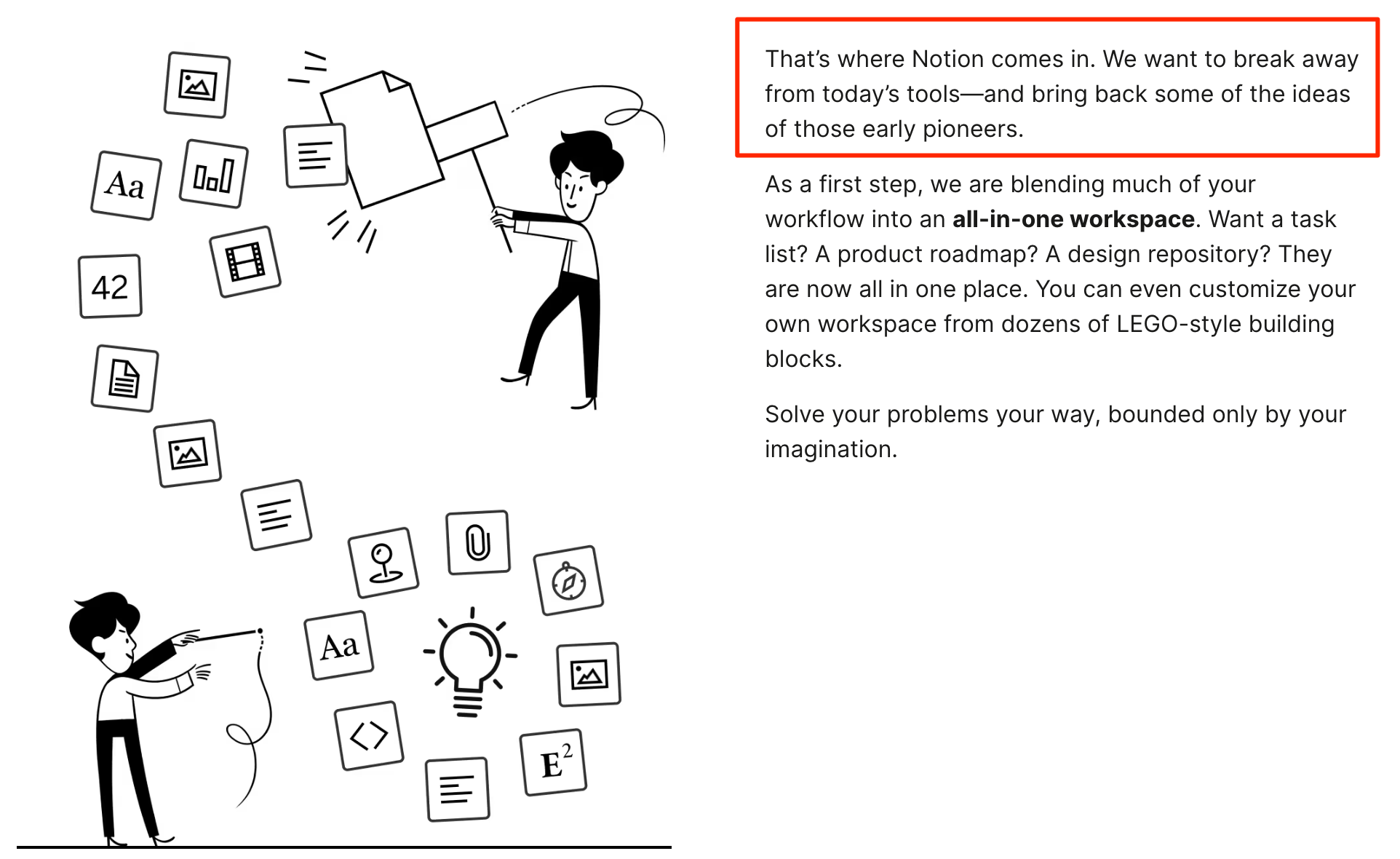
They also frame the problem in the experience, not in features (“databases + docs”). Like so:
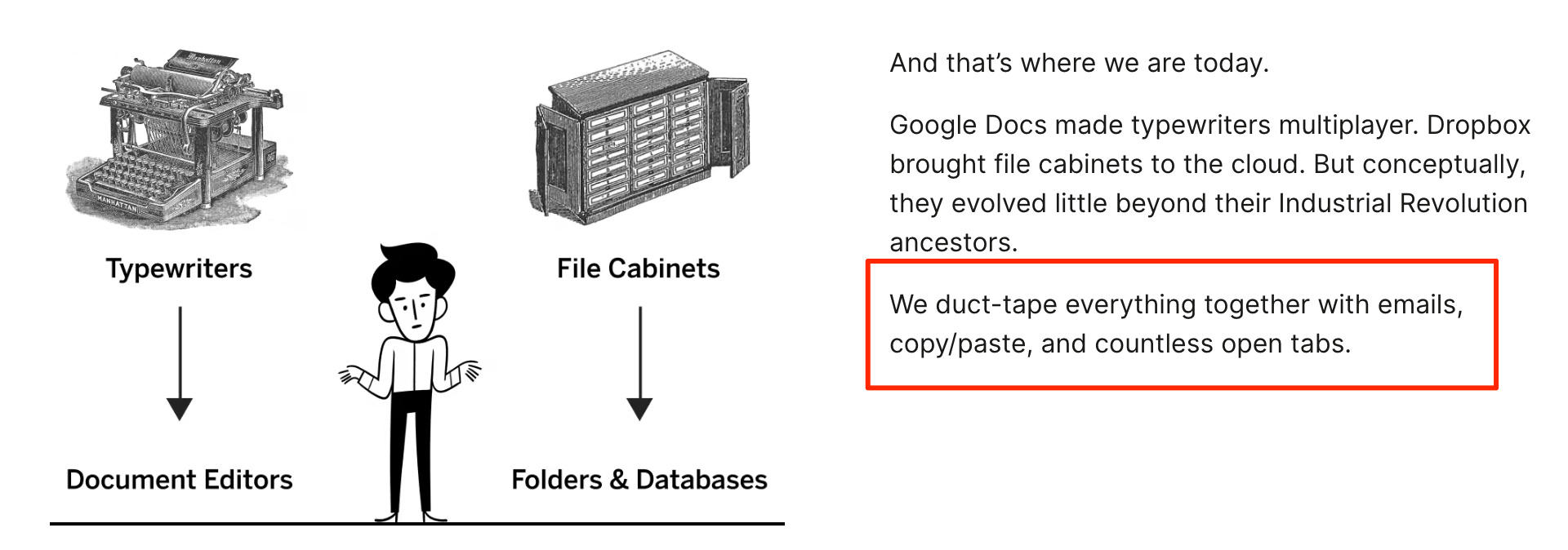
How the story shows up in their messaging
Notion's blog describes how their latest brand campaign was built to “expand people’s understanding of Notion beyond productivity software. We often describe Notion as a set of building blocks—like LEGO—that gives users infinite variations.”
Then, there's the “Customers” page. It highlights how companies use Notion to bring all knowledge, tasks, and projects into one workspace. It includes direct customer testimonials such as:
- “Every day is a new canvas that we can structure however we want.” — Alex Cornell, Co-founder, Cocoon
- “Notion saved our life given the complexity of what we’re doing.” — Ben Malartic, Product Manager, Privateaser
These stories reinforce the narrative of flexibility and user control.
What to take away for your own brand story
- Notion clearly identifies the industry pain (“fragmented tools”) and maps their solution to that pain in language accessible even to non-technical audiences.
- They surface user testimonials that align with the narrative (workspace as canvas, freedom, structure).
- They reinforce the story visually and verbally (illustrations of building blocks, “infinite variations”).
- They lead with how work should feel and allow the product to follow.
Gong
Gong frames its story around a simple but potent truth: in B2B sales, decisions are too often based on guesswork, louder voices, and internal bias rather than the actual voice of the potential customer. Their narrative is that “revenue intelligence” should mean hearing the customer, not just dashboards.
For example, in a brand identity story, they explained: “We’re about empowering people to sell. We’re all about helping individuals be the best they can be.”
How the story shows up in their messaging
- In a blog post about their rebrand, Gong described how their mascot, Bruno the bulldog, symbolized their human-side roots while they evolved into a partner for enterprise organizations.
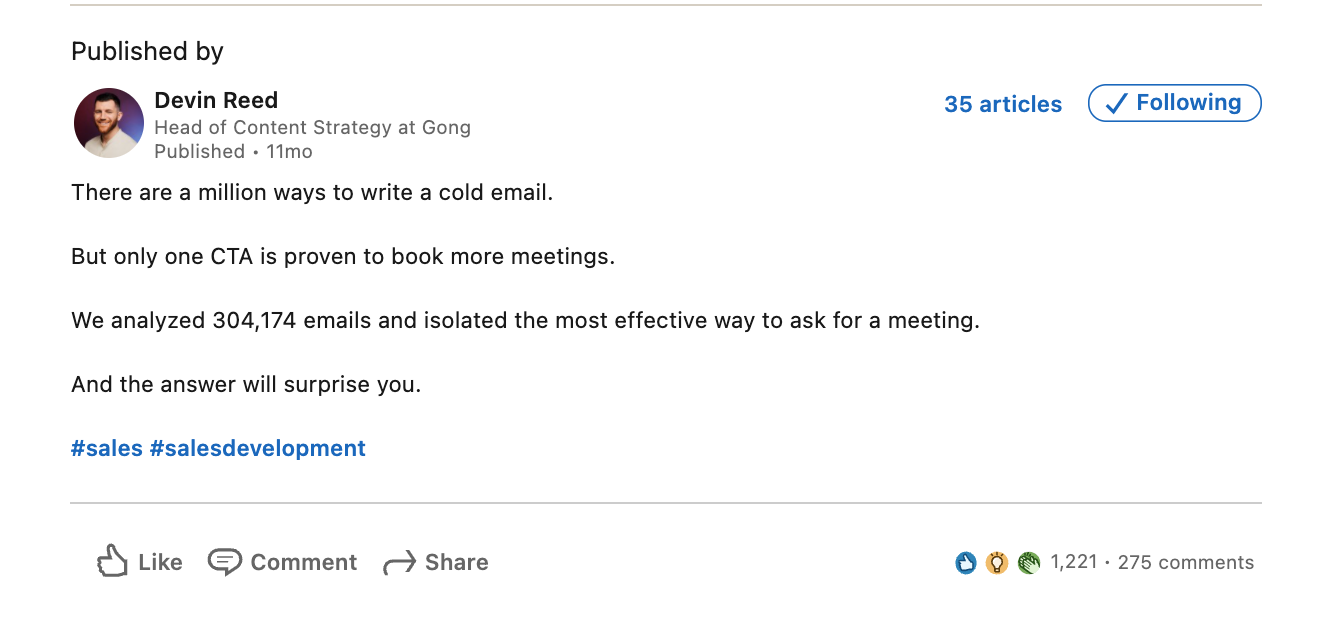
- Their LinkedIn and content strategy emphasizes data-driven insights for sales—posts analyzing large volumes of emails, sharing learnings, and humanizing sales work. For example, one post uses the “Analyzed X assets—here’s what we found.” approach:
- Their visual identity (colors, shapes, energetic tone) reflects a belief in human clarity and boldness over bland tech minimalism.
What to take away for your own brand story
- Gong rooted their narrative in a tension their audience felt (sales org frustration with guesswork) and centered the brand as the one offering reality-grounded insight.
- They use content and social boldly—not just product updates, but publicly-audited data, commentary, and community involvement.
- They evolved their visual identity to align with narrative maturity (from startup to large enterprise) while retaining human essence.
- They embed the story across touchpoints (website, blog, social, internal culture) to make their story muscle memory.
Master brand storytelling with MarketerHire

To build a compelling brand story, you need to make your buyers the main character. Focus on what their experience and the future they expect to build. Define the belief behind your company, then reflect it consistently in onboarding, product decisions, sales language, landing pages, and leadership communication.
That's how it'll become the culture, and culture becomes customer loyalty.
If you want seasoned brand and content leaders to help you write a brand story, you've got to try MarketerHire. You can bring in a fractional brand strategist to structure your messaging architecture, a senior content leader to carry that story into campaigns and content systems, or both—without committing to a full-time hire before you’re ready.
These professionals work directly with your leadership, sit in key meetings, document your brand’s narrative, and help your team apply it across channels so the story shows up across all touchpoints.
Build the marketing talent mix that supports your next stage of growth.
