
- Template item
SaaS content carries three core responsibilities: driving qualified demand, helping users activate quickly, and engaging existing customers so they don’t churn.
To meet those goals, every asset—whether it’s a comparison page, onboarding guide, or support article—needs to be built with growth metrics in mind. If it doesn’t connect to acquisition, activation, or retention, it’s wasted content marketing effort.
Why SaaS needs content that converts

SaaS growth depends on a chain of decisions: a prospect needs to recognize the problem you solve, decide your product is worth the spend, commit to recurring charges, and continue seeing value long after onboarding.
Every one of those touchpoints is fragile, and strategic content is what strengthens them.
The question for SaaS leaders isn’t “How much website traffic did we drive?” but “How much stability did this content create?” Teams that measure against activation, retention, and expansion see the connection between content and predictable MRR.
Think of the customer lifecycle—awareness, acquisition, activation, retention, expansion—as the map. Your SaaS content marketing strategy is the system that moves buyers through it.
Your 7-step SaaS content playbook
The playbook below shows how to build a successful content marketing plan in practice.
1. Build buyer narratives, not static personas
Personas summarize who your buyers are (“CTO at mid-market company”), but they rarely explain how real people discover, evaluate, and justify your product. Narratives do. They capture the sequence of searches, conversations, and proof points a buyer encounters before committing.
For SaaS, this path often looks less like a neat funnel and more like a series of loops. A developer might Google “API monitoring errors,” land on a troubleshooting blog, sign up for a free tier, hit usage limits, read a case study on scaling with your tool, and finally upgrade. Each touchpoint pushes the decision forward or stalls it.
When you chart these narratives, you gain a blueprint for quality content placement. The troubleshooting blog answers the first technical hurdle, documentation supports the trial, and comparison pages equip champions for internal debates. If you can’t trace what your ICP is reading and thinking at each stage, your content won’t move pipeline.
2. Translate features into business outcomes
Once you know how buyers move through the customer journey, the next step is clarifying why they should care. Features describe what your product can do, but SaaS decision-makers care about the measurable impact. They want to know: How much faster? How much cheaper? What KPI does this improve?
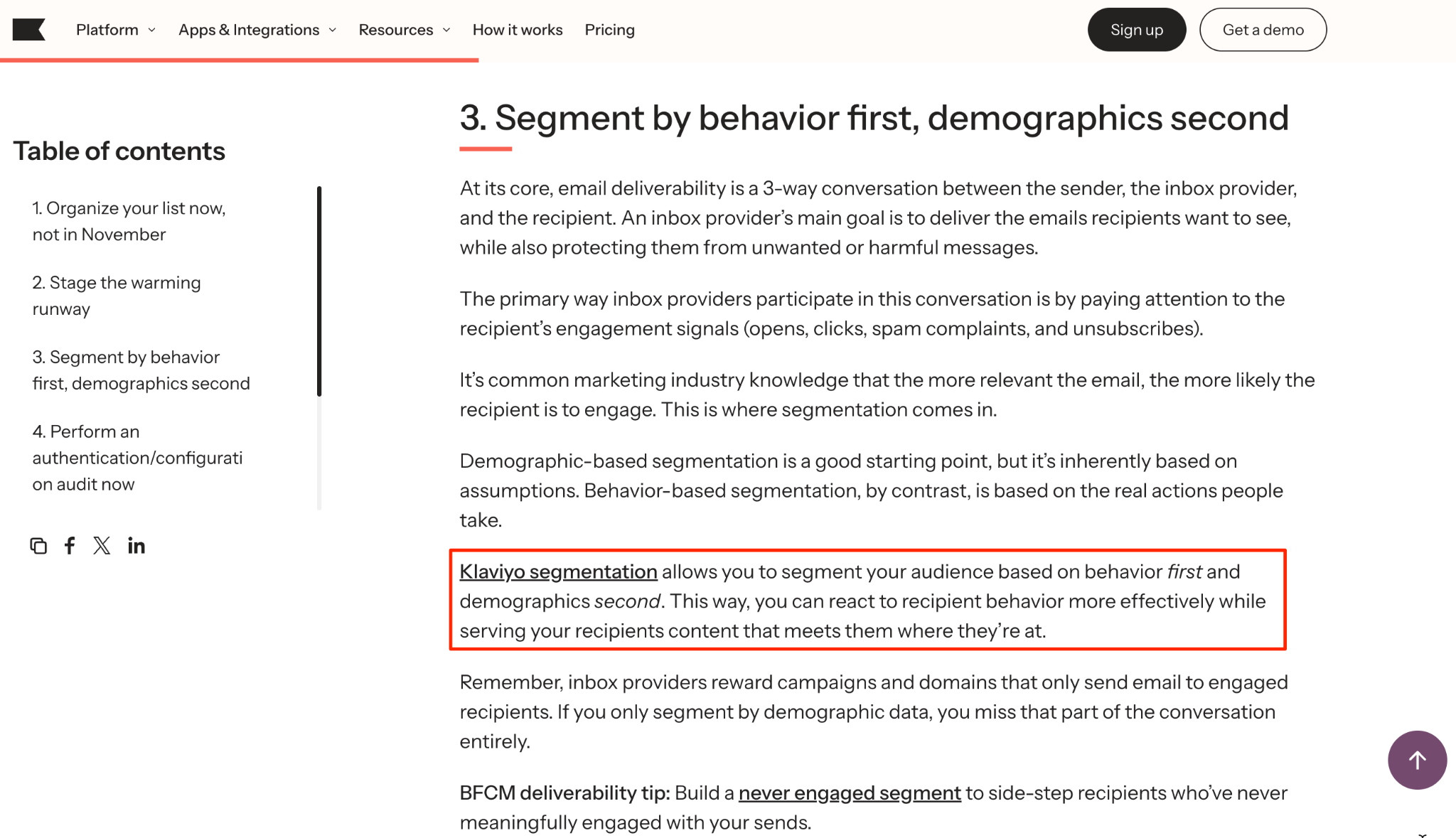
Take reporting features, for example. Instead of saying “streamlined reporting,” show that you cut reporting time from 10 hours to 1 hour per month, freeing $4,000 in team productivity. Klaviyo often takes this approach, linking platform features to benefits (e.g., improved email deliverability) and backing claims with customer data.
To make this repeatable, build a grid pairing each feature with the SaaS business metric it improves (e.g., time-to-value, churn, CAC payback). Brief every piece of content against this grid so writers ground messaging in numbers, not adjectives. The result is content that speaks the same language your buyers use in budget conversations.
3. Build funnel-aligned keyword clusters
Search intent shifts as buyers progress from identifying a problem to deciding on a vendor. To capture that progression, structure your keyword research as a funnel.
At the awareness stage, prospects type problem-focused searches like “how to reduce downtime.” Here, in-depth guides and tutorials provide context. In consideration, they search for solutions—“best uptime monitoring tools”—and expect structured comparisons. At the decision stage, they get specific: “Datadog vs. New Relic.” This is where decision pages, ROI calculators, and customer stories win the argument.
This way, your content library maps directly onto the buyer’s journey, ensuring you’re visible at every step with the right type of content and message.
4. Set OKRs that tie directly to growth levers
Visibility in search and strong messaging are progress, but you need to prove that progress translates into growth—and pageviews and impressions don’t tell that story. You should tie objectives directly to revenue mechanics.
- Acquisition: Did this content generate qualified trials/demos?
- Activation: Did onboarding docs shorten time-to-first-value?
- Retention: Did help guides reduce churn by making features stick?
- Expansion: Did advanced benchmarks or tutorials drive upsells?
Track these metrics in your CRM and product analytics so they show up alongside your sales and success data. When your leadership sees content driving acquisition and retention—not just traffic—they’ll recognize that your content marketing is actually fueling growth.
5. Design content as modular, reusable assets
With goals aligned to growth, you can now get more out of each investment. A single flagship piece should power multiple touchpoints rather than stand alone. A benchmark report, for instance, can launch as a PDF, then create content formats as needed:
- a long-form blog post to highlight key findings
- a sales one-pager to show ROI
- a webinar deck to walk through insights
- LinkedIn posts to spark demand
- onboarding emails to reinforce credibility with new customers
Treating each flagship asset as a “content kit” ensures consistent messaging across channels while reducing production costs. Instead of constantly reinventing, you’re recombining and extending, which compounds reach and keeps your story coherent everywhere your target audience engages.
6. Distribute content through the entire lifecycle
Even the most modular content has limited impact unless it reaches the right stage of the buyer’s journey. That's why your distribution strategy should embed content where it will influence a decision.
Consider this: in search engine optimization, a comparison blog attracts pre-trial buyers weighing options. Repurpose it into nurture emails that guide trial users toward activation. Later, adapt it into onboarding collateral that reinforces value post-purchase. The same piece keeps moving prospects along because it’s been placed with intention.
When every asset has a mapped role—whether pre-trial, mid-trial, or post-purchase—you avoid wasted content and ensure distribution multiplies value over time.
7. Manage content like a product backlog
A SaaS product evolves continuously, and your content library should be managed with the same discipline. Run quarterly audits to identify assets worth refreshing, prune those that no longer reflect your product, and A/B test new CTAs or formats. Use attribution data to evaluate ROI, and let sales, product, and success teams feed requests into a backlog that you evaluate like feature requests.
This process keeps your library lean and compounding in value. Instead of a bloated archive no one uses, you have a system where each asset either earns its place or is replaced by something stronger.
Read More: 6 Best SaaS Digital Marketing Agencies in 2025
How SaaS brands execute content: real-world examples
Let's look at how different SaaS companies approach content—and what you can adapt for your own marketing team and improve your overall content marketing strategy.
Atlassian – hub-and-spoke authority
If you want to dominate a category, don’t publish scattered articles. Atlassian builds structured hubs around themes like agile and ITSM. Each hub starts with a comprehensive guide, then branches into related pieces that cover every angle of the topic. This approach signals authority to search engines, creates a self-contained learning path for readers, and naturally pushes traffic toward product templates and trials.
Ahrefs – product tutorials as engaging content
Ahrefs shows you how to solve SEO problems inside its own platform. Their blog doubles as a training library, where every “how-to” is also a product demo. By the time readers finish a guide, they’ve already experienced the value of the tool—without creating an account. If you want content that converts without heavy ad spend, use tutorials that let prospects “use” your product while they learn.
SparkToro – research as a growth and credibility lever
SparkToro wins attention by publishing original studies on audience behavior and marketing trends. The data fuels backlinks, social media platform shares, and industry conversations. You don’t need a huge marketing team to do the same. Even small surveys or analyses of your own user data can produce reports that stand out and position you as a credible voice in your space.
Hotjar – content built on jobs-to-be-done
Hotjar structures its blog around the exact workflows its tool supports: heatmaps, session recordings, and surveys. Each article helps readers solve a UX problem step by step while showing how the product fits into the process. When your content lines up with your product’s top use cases/customer jobs, it doubles as both education and onboarding.
Building the right content team + briefs what work
Start with a lean, strategic core team
Scaling SaaS content focuses on building a team structure where content strategy drives execution. At the minimum, you need:
- Content strategist or lead who owns the roadmap, ties content to OKRs, and prioritizes with the discipline of a product manager.
- Content marketing manager who turns your B2B SaaS content marketing strategy into action, manages freelancers, and ensures deadlines stay tied to business goals.
- Specialists on demand (writers, designers, SEOs, video editors) you can bring in when needed without long-term headcount.
Write briefs that tie content to growth goals
Your content brief is the framework that makes sure content solves the right problem and drives the right metric. Each one should define:
- Audience and stage: Who the piece is for and where they are in the funnel (for example, a VP of Finance comparing vendors).
- Problem and proof: The challenge being addressed and the specific evidence that builds trust.
- Growth objective: The outcome you want to influence—demo requests, trial conversions, or upsell adoption.
- Distribution plan: The channel strategy that ensures it reaches the intended audience, from organic search to in-app prompts.
When to choose MarketerHire
Most SaaS teams design the right structure, then stall when it’s time to staff every role. Headcount is capped, recruiting drags on, and product deadlines don’t wait. MarketerHire gives you immediate access to senior marketers who can step into those gaps without the usual delay.
Instead of waiting through months of recruiting, you can bring on a strategist or SaaS writer in a few days. If your board expects a new round of case studies ahead of fundraising or your GTM launch requires twice the usual content, you can flex your team up without making permanent hires. Every marketer is vetted for SaaS experience, so quality and fit aren’t a gamble.
For founders and marketing leads, this means projects stay on schedule and budgets stay predictable. You keep the benefits of a full team without locking yourself into long-term payroll. Explore content marketing roles and strengthen your SaaS content marketing efforts with MarketerHire.
