
- Template item
Founder-led LinkedIn marketing works because it gives buyers something they can't get anywhere else: access to how a founder thinks and their experience.
That’s why founder content consistently outperforms brand handles: 2–5× higher engagement and, for many companies, more than 70% of organic pipeline influence.
People respond because the voice is earned. A product insight, a hiring philosophy, or a customer moment that changed how you build and create trust faster than marketing copy ever could.
More marketing teams are now formalizing this into what I call the Founder-Led Demand Engine: a system where leadership owns the narrative, and a strategist, ghostwriter, and marketing ops partner keep it scalable.
This playbook teaches you how to build that system.
Why Founders Are Their Own Best Marketers

Founder-led marketing is narrative ownership. It shapes how the market understands your product, your category, and your point of view before competitors define it for you.
If someone follows you on LinkedIn, they want to know:
- how you think
- what’s changing in your market
- what you’re experimenting with
- how you solve problems your buyers also face
Marketing can scale the stories, sales can distribute them, and employees can amplify them. But only founders can originate them, because only they hold three things no marketer can replicate:
1. Vision
Your advantage as a founder is perspective.
You see market changes early because you’re working inside the shift. When you publish, your audience gets context behind your product decisions, hiring choices, pacing, or strategy changes.
Look at how Mathilde Collin communicates at Front. When she shares company updates, they read like chapters in how the company is being built. Funding rounds, hiring milestones, product launches become signals of where the category is moving and how Front plans to lead it.
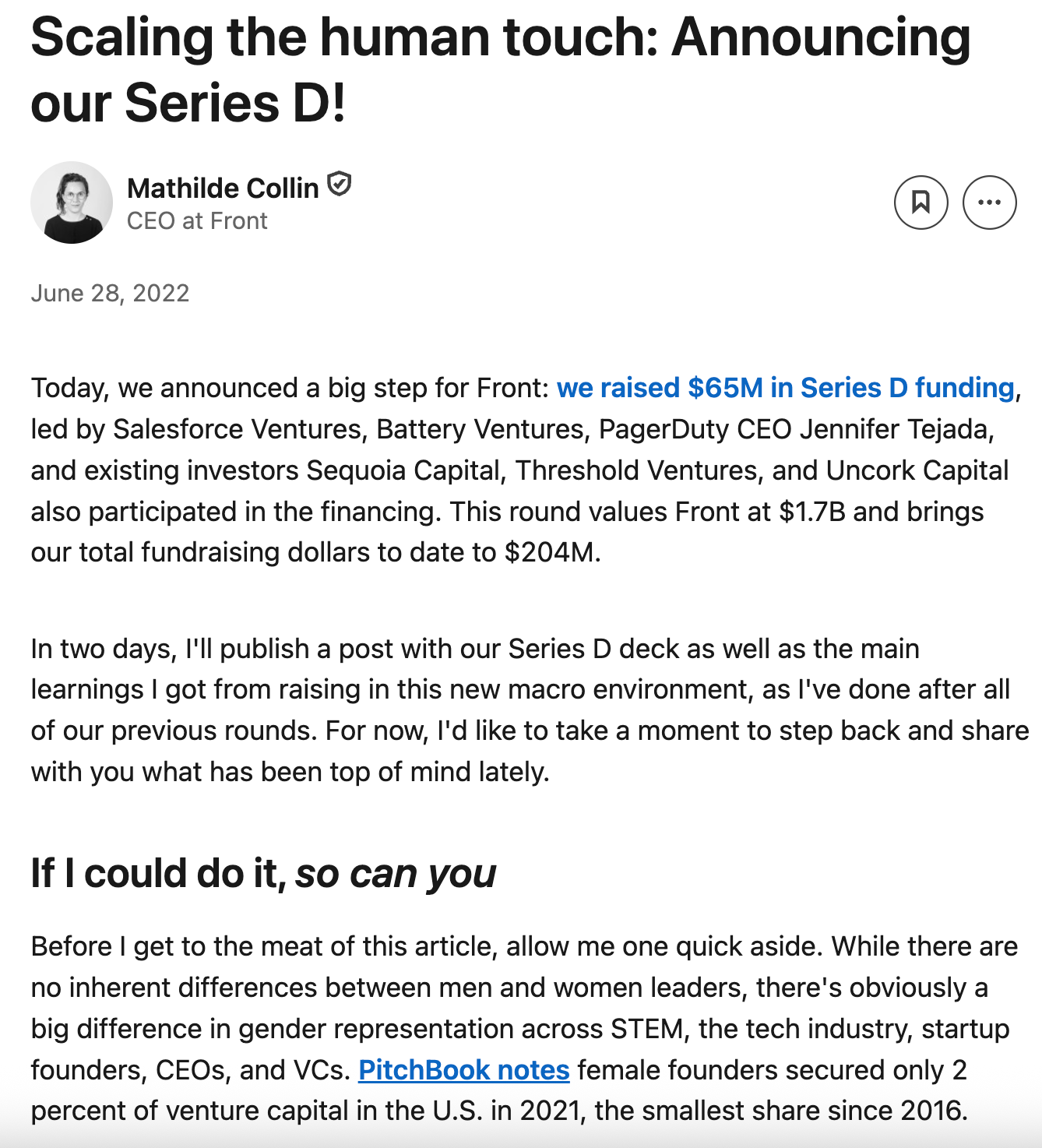
Someone who has followed her for years can see how her thinking and priorities have evolved. That continuity builds confidence.
2. Proof
Experience becomes evidence when you share the decisions behind the outcome.
Nick Mehta at Gainsight does this through his long-running “mistakes I’ve made as a CEO” content series. He explains the original situation, the decision, the consequences, and what he’d repeat or change now.
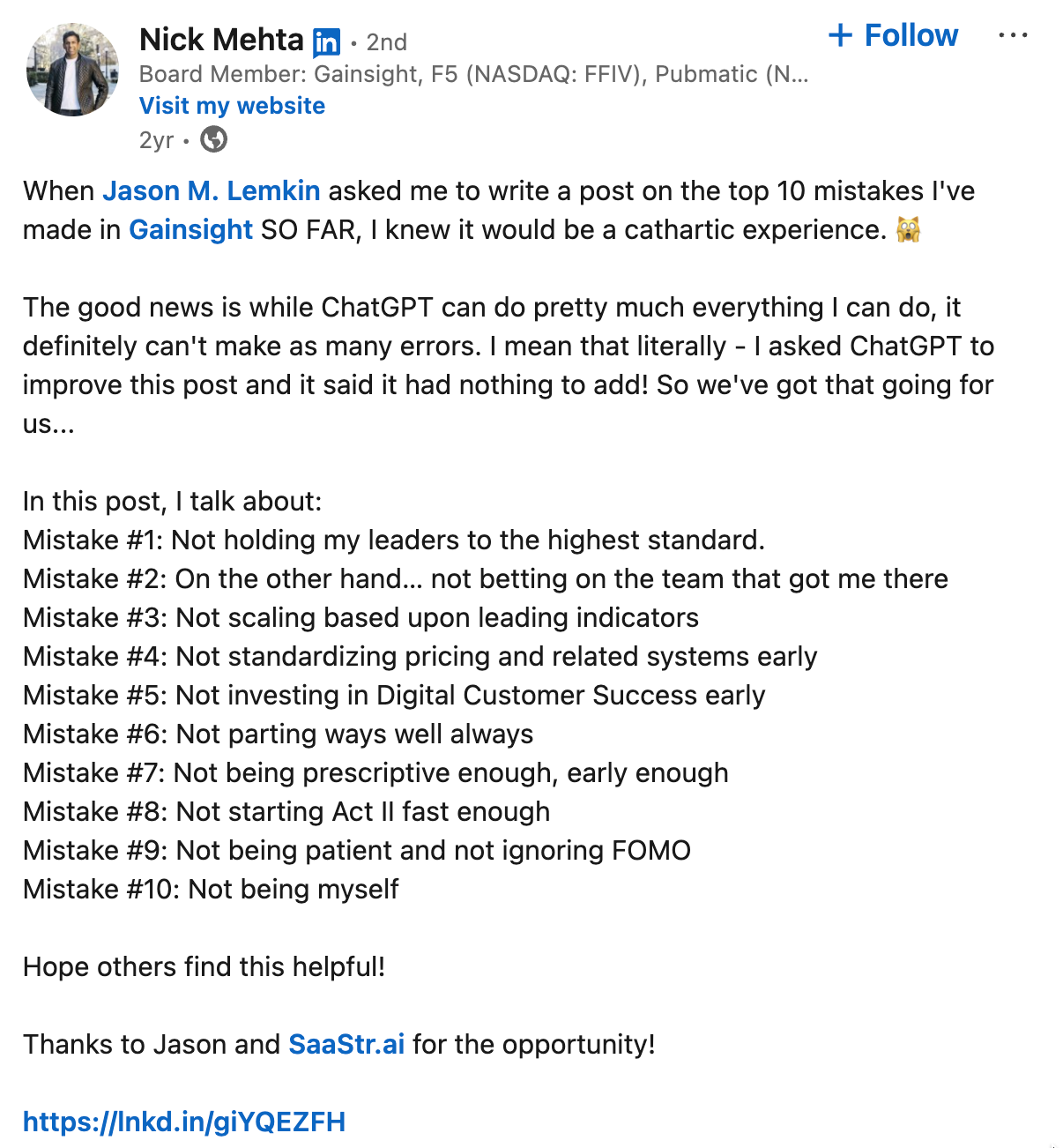
Because Gainsight sells operational rigor to SaaS companies, that level of transparency reinforces the product’s purpose. His content teaches and validates at the same time.
3. Trust
A founder’s words carry weight because they’re tied to someone accountable for outcomes.
Rand Fishkin at SparkToro shares his thoughts about audience and market research, LLMs, and modern discovery channels. And when SparkToro does appear in the narrative, it feels earned, like the obvious tool that fits the viewpoint the reader now holds.
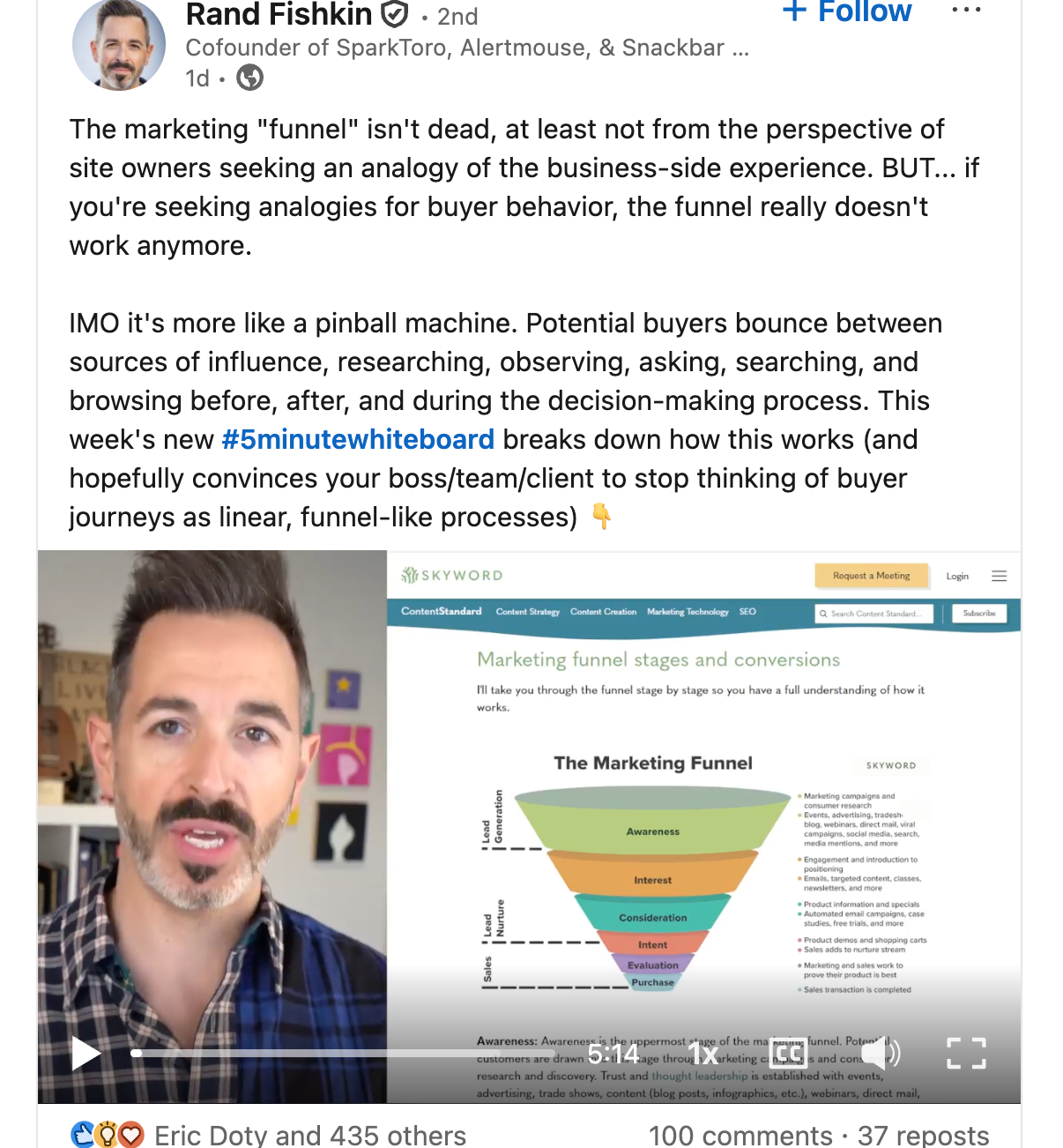
Fishkin doesn't try to pitch SparkToro. He simply mentions it as the natural tool that fits the thinking he just shared.
Why LinkedIn is the ideal platform to generate B2B demand
Of LinkedIn’s 1 billion+ members, 180 million influence buying decisions and 63 million make them. That concentration of buyers is why it’s the best platform for founder-led marketing.
Take Chris Walker’s work at Refine Labs, for example. Between July 2021 and mid-2023, the company generated:
- $50M in pipeline, and
- $14M in closed revenue
from LinkedIn, with zero paid LinkedIn ads and zero outbound. The consistency of insight did all the work.
A founder’s personal posts get more attention than company posts because they feel helpful and based on experience. They feel real. As this builds over time, people start to trust the founder’s point of view and look to them for guidance. And when that happens, LinkedIn becomes part of how they choose what to buy.
Framework for the founder-led content engine
Some days ideas come easily. Other days, you stare at a blinking cursor thinking, I literally have nothing useful to say. That’s normal. Every founder I know who publishes regularly goes through the same cycle.
What makes the difference is having a system that helps you catch ideas before they disappear and turn them into something useful later.
Here’s an approach I’ve seen work—not universally, but often enough to be worth sharing.
1. Capture the raw material
Most of the best material doesn’t show up when you’re “creating content.” It appears during talks with customers, product debates, investor feedback, or moments when something finally clicks after weeks of fuzziness.
I used to lose/forget those ideas. Now I just write a sentence or two somewhere I trust I’ll return to. Sometimes it’s a note on my phone. Sometimes it’s a screenshot. Sometimes it’s a voice recording.
Don't worry about organizing it at the moment. Just save them. After a few weeks of doing this, you’ll notice clusters—pricing, positioning, product philosophy, leadership, customer behavior, market direction.
Those clusters are your raw material for posting.
2. Organize ideas so it’s usable
Eventually, your ideas will become hard to keep track of if they’re scattered everywhere. So give them one place to live.
The tool doesn’t matter. Notion, Google Docs, a shared folder, even a notes app. What matters is that you can find things later.
Also, add a bit of structure so that it's easier to sort and use the ideas. Like so:
- Active ideas: things you’re still thinking through
- Established beliefs: the ones you’re confident sharing publicly
- Examples: screenshots, links, or stories that reinforce a belief
- Decisions: what changed and the reasoning behind it
With everything organized, content takes form faster. Plus, your team will have a clear source of truth when they need direction or alignment.
3. Build a support layer
A lot of founders assume publishing regularly means hours of writing each week. For some people that’s enjoyable. For others, it’s the thing that stops the habit completely.
Working with a content strategist or writer who can turn your raw thoughts into finished material removes that pressure. You still create the thinking. They help shape it so your audience can follow along.
The relationship matters more than the toolset. You want someone who gets how you think and isn’t afraid to push or ask questions when the idea needs another round.
Fractional support is usually enough. You don’t need a full content team to maintain a steady rhythm. In most cases, one person who meets with you regularly, extracts ideas, and turns them into publishable drafts keeps the cadence moving. Learn more about how to hire a LinkedIn expert.
4. Share useful posts beyond LinkedIn
A funny thing happens once you’ve been posting for a while: certain ideas start showing up in sales calls, customer replies, even internal team conversations. When that happens, it’s worth bringing those ideas into other places your customers rely on for guidance.
I like saving those posts in one shared place and tagging them by topic. Later, they often turn into clearer messaging to explain a product decision, refine positioning, or onboard someone new.
No need to build a formal rollout, though.
If an idea helps people communicate more clearly, it tends to spread on its own. And when the company starts repeating language that began as a post, that’s usually a sign the system is working.
Building an amplification loop
An amplification loop is where your thinking doesn’t just sit on your profile. It gets echoed, referenced, shared, and applied by other people.
Here’s a version of how it tends to form.
Step 1: Pay attention to who’s paying attention
Engagement metrics on LinkedIn can feel shallow if you treat them like a scoreboard. But if you look beneath the numbers, there’s interesting information hiding there.
For example, a few patterns worth noticing:
- when someone in your ideal audience keeps showing up, liking, or asking questions
- when someone who never engages suddenly does
- when a topic triggers longer comment threads instead of quick emoji reactions
Those moments usually mean your idea landed somewhere meaningful.
I like jotting down names when this happens or adding a short CRM note so I remember the context later. Not to “convert” them. More so I can follow the thread if something comes of it.
If you use tools to automate this part, great. If not, a simple habit works fine.
Step 2: Invite employees into the distribution
One thing I’ve seen go sideways is when companies try to orchestrate engagement from employees. People can tell when it’s forced.
A lighter touch seems to work better. You can:
- share new posts in an internal channel with a short explanation of why the topic matters
- offer a few angles people might use if they feel like commenting or reposting
- highlight good employee posts so others see what “authentic contribution” looks like
Some employees will comment. Some will repost with their own take. Some will just read it.
All of those outcomes are useful. If you do this well, you'll start to see customers interacting with employees directly, which is often where useful insights and relationships begin.
Step 3: Revisit strong ideas in new formats
If something sparked meaningful conversation, it’s usually worth revisiting from another angle.
For example, a short text post can grow into a longer thread with examples. Or a story that worked in text can be retold as a short video or a slide-style post. Even a lively comment exchange can inspire a follow-up piece that addresses the main questions
Think about how you would handle a talk you give at a conference. You do not rewrite it from scratch every time. You refine it, add proof, improve the stories, and bring it to new audiences.
The same principle applies here.
Read More: Repurposing Content for SEO
How you’ll know it’s working
At some point, the amplification loop shows up outside LinkedIn.
You might hear prospects say they have been reading your LinkedIn posts for months. Or candidates may reference posts during interviews
You can track this informally at first. Ask new customers where they first heard about you. Add a field in your forms for “founder content” or similar. Listen for mentions of specific posts in sales calls and support tickets.
Once you start seeing these signals consistently, the loop is working. That’s the point where it makes sense to shift from anecdotal feedback to measuring impact.
Metrics that prove ROI

Meaningful reach
It’s useful to track impressions, but impressions only matter when the right people are on the other side. The better metric is how much of your reach comes from people who match your ideal audience. You’ll see this in profile views and engagement details. If the names start aligning with titles and companies you would deliberately sell to, that’s progress.
Most founders I’ve worked with start around single-digit relevance. After 60–120 days of consistent posting, it usually rises into the 20–40 percent range. That shift signals that the right people are watching regularly instead of accidentally.
Intent signals
When readers move from light reactions to thoughtful engagement (questions, shared challenges, interest in next steps), you’re beginning to influence their thinking. Track:
- DMs or comments that ask for examples, clarify context, or explore how you solve pain.
- Engagement depth: length of comments, follow-up threads, meaningful feedback.
- Actions like visiting pricing or about pages, downloading resources, or requesting a call.
Pipeline behavior and velocity
Content-influenced deals often unfold differently than cold outreach. Typical patterns include:
- Shorter sales cycles because early education already happened through posts.
- More qualified meetings (think: fewer exploratory calls, more solution-fit conversations).
- Leads entering mid-funnel with clarity and alignment.
Compare how quickly deals close, how often they convert, and how strong those deals are when they start from LinkedIn vs. other channels. That will show whether your content is improving pipeline performance.
Revenue traceability
Specific attribution is tricky, but not impossible. You can start with:
- A field in your lead form (e.g., “How did you hear about us?”)
- Manual tracking: when prospects cite a post, idea, or founder’s POV as reason they reached out.
- Measuring pipeline & closed deals from leads who mention content as their first touchpoint.
Internal confirmation
Eventually, the most compelling evidence isn’t in analytics but in how the company feels. Sales mentions smoother calls. Recruiting hears applicants reference posts. Customers begin repeating your language in their own messaging.
Those moments matter more than any chart. They show your voice is influencing how the market views the problem, the solution, and your company.
Read More: How To Create A Go-To-Market Strategy in 2025
Get more consistent with MarketerHire
In founder-led content, consistency is usually the missing piece. The ideas show up every day in customer conversations and product decisions, but writing them down rarely makes it to the top of the to-do list. So posts become occasional, then rare, then nonexistent.
Working with someone part-time can keep the cadence steady. They listen for the insights already happening across the business and shape them into posts that sound like you. The writing continues even during weeks when you can’t get to it.
MarketerHire makes it easy to find that kind of partner. Rather than searching on your own or guessing with freelancers, you’re paired with a ghostwriter or content strategist who already knows how to support founders and maintain a reliable publishing rhythm.
Hire your LinkedIn Content Writer today..
FAQs
What if I don’t have time to post on LinkedIn regularly?
You don’t need hours each week to make this work. A short recurring conversation where you share what’s happening inside the business gives someone else enough material to turn into consistent posts. Your job is the thinking. A LinkedIn content writer can handle the writing and distribution.
How often should a founder post on LinkedIn?
Two or three useful posts per week are enough for people to remember you and build familiarity over time.
What if I run out of things to say?
If you’re building a company, you won’t. Every week brings decisions, lessons, customer conversations, product shifts, and unknowns you’re working through. The key is capturing them while they’re fresh instead of waiting until you’re “ready to write.”
Is it still authentic if someone helps me write?
Yes, it stays authentic as long as the ideas come from you. A good writer will help you express your thinking more clearly and keep it consistent over time. It’s similar to getting help with design or finance—the work is still yours, just better executed.
How do I track whether LinkedIn is actually driving revenue?
Start with simple attribution. Ask new leads how they first heard about you, listen for content references in sales calls, and note when prospects already understand your positioning before discovery. Those signals will begin showing up in faster deal cycles and higher-quality inbound.
