
- Template item
In 2026, business growth will come from generating demand with the right buyers, at the right time. That’s the essence of demand generation. Unlike quick-hit lead gen, demand gen builds awareness, nurtures intent, and positions your brand as the clear choice across the buyer’s journey.
A B2B demand generation agency helps you move past cold outreach and one-off campaigns. Instead, they design programs that generate demand consistently—using account-based marketing, content, paid ads, and marketing automation. And the best ones? They deliver qualified leads and measurable revenue growth.
If you’re debating whether to outsource or build in-house, you need to know when an agency makes sense—and why demand generation should take priority over lead generation.
When to know you need a B2B demand generation agency

Even the best sales teams stall when marketing isn’t generating a steady flow of opportunities into the pipeline. A demand generation agency can be the missing piece if you notice these signs
- Your pipeline is inconsistent. Cold outreach only goes so far. Agencies create inbound and ABM campaigns that make revenue more predictable.
- Your team is maxed out. Scaling SEO, content, paid campaigns, and sales enablement takes skills your team may not have. Agencies bring the expertise and bandwidth to move faster.
- Your programs aren’t scaling. Webinars, content syndication, and multi-channel ads don’t run themselves. They need coordination—timelines, messaging, budgets, and follow-up. Agencies manage those moving parts so your campaigns hit your target accounts without burning out your demand generation team.
- MQLs aren’t converting. If marketing-qualified leads don’t turn into sales-ready opportunities, something’s off. Agencies can align nurture sequences, scoring, and sales enablement to fix the gap.
- Revenue has plateaued. When sales is doing its job but growth has stalled, the issue usually starts higher up in the funnel. Agencies know how to fuel it with ready-to-buy prospects.
Why demand generation matters over lead gen
It’s easy to treat lead generation as the end goal. You get names on a list, and it feels like progress. But without demand generation behind it, those names rarely turn into customers. Lead gen is transactional—you collect contacts. Demand gen is strategic—you build trust, authority, and intent so those contacts are ready to buy when they enter your sales funnel.
This difference shows up in sales cycles. With demand gen, buyers already know who you are and what you stand for. They’ve read your content, seen your expertise, and trust your brand before they ever talk to sales. That means shorter conversations, less pushback, and higher deal values. Instead of convincing someone why they should care, you’re guiding someone who’s already halfway there.
Demand generation also builds long-term equity for your business. Quick-hit lead gen campaigns may spike numbers for a moment, but they don’t create lasting growth. When you invest in demand gen, you’re creating a system that fuels your funnel month after month with prospects who are primed for your solution. That’s why top B2B companies put demand gen first—it compounds over time and turns marketing into a reliable tool for revenue growth.
For more context, see how B2B demand generation and lead gen synergize to build a stronger pipeline
How B2B demand generation differs from B2C
Your demand generation strategy will look very different depending on whether you’re selling to businesses or consumers. For B2B companies, the stakes are higher, the timelines are longer, and the tactics must align with complex buying processes.
Longer buying cycles with multiple stakeholders
In B2C, a customer might decide in minutes or hours. In B2B, deals can take months and often involve a committee of stakeholders, procurement teams, and executive sign-off. That means you can’t just push out a single message and expect results. You need content and campaigns mapped to every stage of the buyer’s journey—showing ROI, addressing objections, and proving value to each decision-maker in the room.
Messaging emphasizes ROI and expertise
B2C marketing leans on impulse and emotion—think limited-time offers or aspirational storytelling. B2B buyers expect something different: proof that your solution solves real business problems, reduces risk, improves efficiency, and drives revenue. This is why demand generation is so closely tied to thought leadership. When you establish your brand as the expert, you’re not just selling—you’re building trust.
Channels are specialized
A consumer campaign might thrive on Instagram or TikTok. For B2B, those platforms usually don’t move the needle. Instead, you’ll find the best traction in channels designed for professional engagement: LinkedIn campaigns, webinars, industry conferences, and highly targeted ABM. A good agency doesn’t just pick channels—it matches them to where your specific buyers spend time.
Measurement looks beyond volume
In B2C, volume matters—impressions, clicks, and purchases. In B2B, success is about quality and movement. A B2B marketing expert examines metrics such as pipeline velocity, lead-to-opportunity conversion rate, average deal size, and sales cycle length. Here, a strong demand generation campaign focuses on advancing the right potential customers into opportunities.
Key demand generation agency services
Top demand generation agencies build systems that bring marketing and sales together around qualified leads and scalable growth. Their core demand generation services are:
Inbound marketing strategy and funnel design
From SEO and content marketing to webinars and digital marketing campaigns, these agencies create the inbound paths that attract potential buyers at scale. The goal isn’t just traffic—it’s to move prospects smoothly into your funnel with the right mix of education, engagement, and intent-building.
Marketing automation that works
Segmentation, scoring, and lead nurturing are the backbone of modern demand gen. Automation ensures that the right messages reach the right people at the right times, allowing your sales team to focus on potential leads instead of chasing dead ends. Done well, it directly improves conversion rate optimization.
Sales enablement support
Marketing can generate demand, but sales has to close it. That’s why strong agencies equip your reps with the tools they need: custom messaging, case studies, competitive battlecards, and collateral that speaks directly to buyer pain points.
Traits of top B2B demand generation agencies
The best demand generation agencies prove their worth by how well they connect strategy to revenue. They operate as growth partners, shaping how you attract, engage, and convert buyers. Below are the traits that set them apart—and who’s doing it well.
Inbound and SEO execution
Inbound programs succeed when they capture intent, not just traffic. A strong agency will build a content roadmap that mirrors how your buyers search, layering educational resources with keyword strategies that target every stage of the journey.
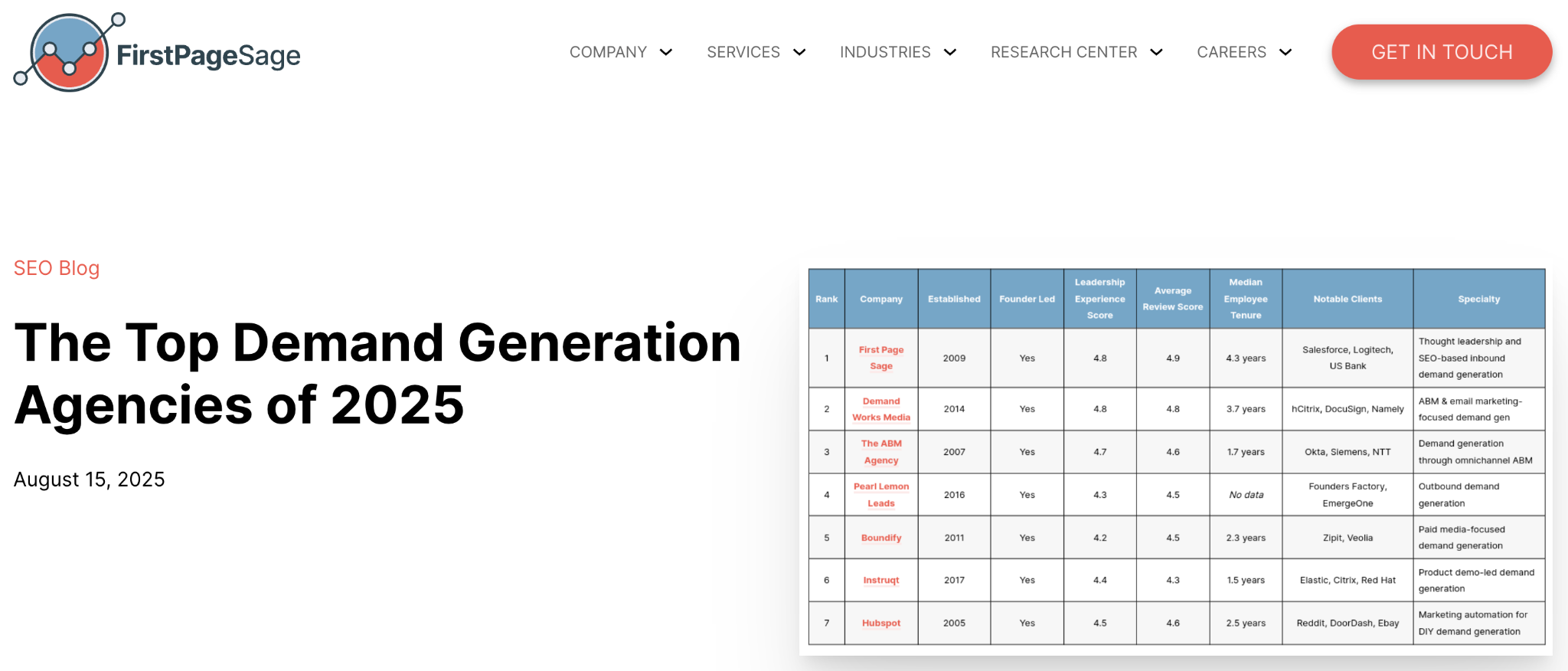
Eventually, this creates a compounding effect: every new article makes the next one easier to rank, and the leads you capture come in with higher purchase intent. First Page Sage is a prime example. Its long-form SEO campaigns for B2B tech firms have consistently lowered CAC while fueling reliable inbound pipelines. The agency also publishes benchmark studies on SEO ROI, which sets it apart as an authority in this space.
Account-based marketing programs
ABM becomes powerful when campaigns feel like they were built for a single account. Agencies that excel at this coordinate plays across LinkedIn, email, webinars, and tailored landing pages. They measure engagement signals to show which accounts are ready for sales outreach and which need more nurturing.
The best partners also segment accounts by value. Tier 1 prospects get deeper personalization and multi-channel orchestration, while lighter-touch tactics are applied to lower tiers. The ABM Agency is known for this structured approach, especially in manufacturing and tech. Its integrated campaigns have increased engagement and pipeline from high-priority accounts that drive meaningful revenue.
Paid advertising with ROI discipline
Ad platforms will happily take your budget. A good agency won’t let them. Instead, they approach paid campaigns as experiments designed to produce pipeline. That means setting hypotheses, testing creative, and refining targeting until you know which offers bring in sales-qualified leads.
Boundify has case studies that highlight this discipline. For DigiPart, the agency achieved an 800% increase in qualified leads by optimizing PPC and paid social campaigns.
Sales and marketing alignment
Revenue gets lost when sales and marketing operate on different timelines. Agencies that understand demand gen close this gap. They map handoff rules, build enablement assets sales reps actually use, and monitor funnel conversion to catch friction points.
Powered by Search shows how this works in practice. In its engagement with Collibra, the team connected paid, organic, and account-based initiatives into one revenue system. The result: new business pipeline targets were exceeded, and cost per lead dropped by more than 20%.
Innovation and modern frameworks
Buyer behavior changes quickly, and strong agencies adapt before old tactics lose their impact. They design programs that account for real but hard-to-measure signals: conversations in communities, referrals in dark social, and the research buyers do on their own. They also use AI-driven targeting and reporting to scale personalization without adding complexity.
After shifting Splash to demand creation and adding self-reported attribution, Refine Labs helped the company book 42% more demo meetings. This proves that agencies using modern approaches, like ungated content and AI-driven reporting, can drive results faster than old lead-gen tactics.
Proof through client success stories
The final test is evidence. Look for firms that publish detailed case studies with real demand gen metrics, not vague testimonials. You want to see examples of shorter deal cycles, increased contract values, or improved close rates.
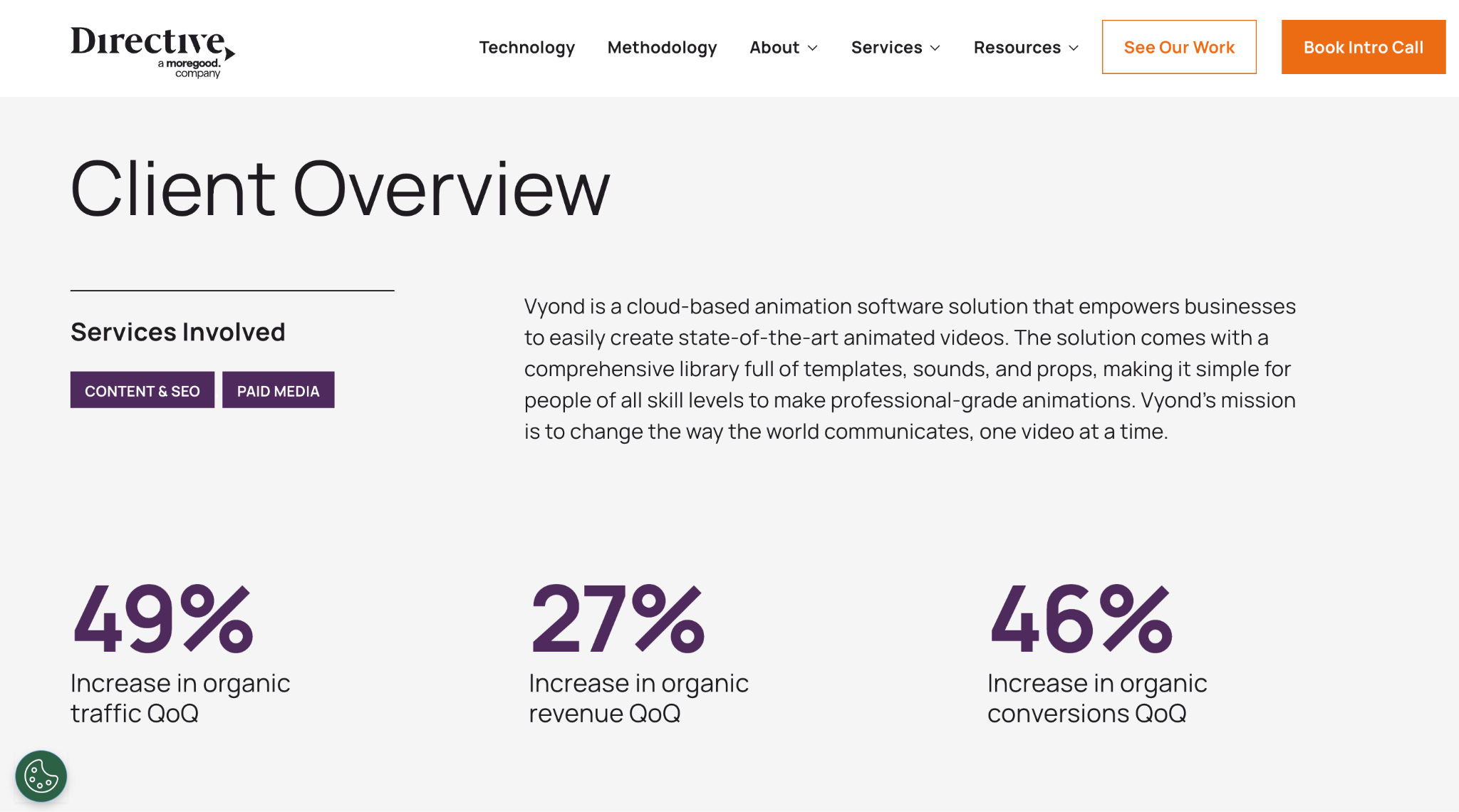
Agencies like Directive Consulting and DemandWorks do this well. Their websites highlight measurable outcomes—pipeline created, deals won, and revenue lifted—that prove their frameworks deliver results you can replicate.
How AI integration with agencies creates competitive advantage
Agencies that integrate AI into their programs help you move faster, target more precisely, and align marketing with revenue goals. The result isn’t just efficiency—it’s a stronger competitive position.
With AI, personalization becomes exact. Agencies can map content, ads, and nurture sequences to a buyer’s stage, ensuring sales teams focus on the right accounts. Predictive analytics improves lead scoring by analyzing engagement patterns—site visits, webinar signups, email responses—and surfacing the prospects most likely to convert. The payoff: better lead quality and less wasted effort.
AI also accelerates content cycles. Instead of waiting weeks for assets, agencies can produce and test multiple variations of blogs, ad copy, and creative in days. That makes it easier to double down on what resonates with your audience and scale campaigns without overwhelming internal teams. At the same time, AI-driven forecasting gives leadership real visibility into pipeline health, so marketing and sales can plan against real growth targets—not assumptions.
In a crowded market, these advantages compound quickly. The earlier you adopt, the faster you move ahead.
Comparing your options: MarketerHire vs. in-house vs. agency
How you build your demand generation engine depends on your stage, resources, and growth goals. Each path—MarketerHire, in-house, or agency—has strengths and trade-offs you need to weigh.
When to choose MarketerHire
You don’t always need a full-service demand generation agency. Sometimes you just need targeted expertise that plugs into your team quickly. That’s what MarketerHire delivers:
- Flexible, on-demand expertise. Bring in a fractional demand gen specialist for the skills you need—whether it’s ABM, content, or paid ads—without locking into a long retainer.
- Fast execution. Test inbound campaigns, launch webinars, or open up new paid channels without waiting months to hire or committing to a year-long contract.
- Seasoned professionals. Every expert has been vetted for industry expertise and experience in driving qualified leads and revenue.
It’s a hybrid model built for speed and control. You can scale campaigns quickly while keeping budgets in check. Ready to go? Bring on a fractional demand gen expert through MarketerHire and start driving growth.
