
- Template item
Launching a new product without a clear go-to-market strategy is like setting sail without a map—you might eventually reach customers, but it’ll be slow, costly, and frustrating. Missed launch windows. Wasted ad spend. Confused messaging. It happens more often than most founders and GTM teams care to admit.
A strong GTM strategy demands more than a few brainstorming sessions. It takes market research, in-depth market analysis, cross-functional coordination, and a deep understanding of your target audience. If your team is already stretched thin trying to build the product, prep sales enablement materials, and keep current customers happy, you may need to hire a go-to-market agency to handle these tasks.
The right agency can help you navigate complex market dynamics, sharpen your positioning, and reach the right audience faster. But the wrong one can leave you overpaying for slide decks that never turn into revenue.
To help you make the right choice, I’ve done the groundwork. In this article, you’ll find:
- 7 great GTM agencies to consider
- A checklist for vetting a GTM strategy partner
- How to measure GTM success
- When to hire a GTM expert via MarketerHire instead of a traditional agency
What is a go-to-market agency?

A go-to-market agency is a specialized marketing agency that helps businesses plan, execute, and optimize the launch of new products or services. Instead of just handling ads or content, they holistically build and execute your GTM strategy, from research and positioning to sales enablement and post-launch measurement.
Here’s what a GTM agency typically handles:
- Market research & in-depth market analysis – They assess the market, your target audience, and your competitors to identify opportunities and risks. This sets the foundation for a strong go-to-market strategy.
- Positioning & brand identity development – They help refine your messaging, unique value proposition (UVP), and competitive advantage so your offering stands out in a crowded market.
- Channel strategy & marketing execution – They determine which channels will most effectively reach your ideal customers and manage campaigns across digital, social, and offline touchpoints.
- Sales enablement & lead generation – They equip your sales team with the right tools, content, and processes to attract and convert qualified leads into customers.
- Performance tracking & continuous optimization – They monitor performance metrics, measure against your business objectives, and adjust tactics to drive measurable outcomes and growth.
- Strategic planning for market entry – They coordinate timelines, resources, and launch activities to ensure a smooth and effective market launch and successful market entry.
Why your GTM strategy matters
Your go-to-market strategy is the roadmap for how you’ll introduce your product, win over target customers, and secure market share. Without one, even a great product can fail to gain traction.
A clear GTM strategy ensures every part of your launch—marketing, sales, and operations—works toward the same business goals. It’s how you position yourself against competitors, choose the right marketing channels, and align your resources for sustainable growth.
It also gives you a framework for measuring results, so you can pivot when needed and market your product successfully over the long term.
When you need a GTM agency
If your launch feels stuck or uncertain, it might be time to bring in a GTM partner. You might need a GTM agency when:
- You’re entering new markets – Expanding beyond your home region requires fresh market research, cultural adaptation, and even a new channel strategy.
- Your team lacks industry expertise – If your expertise lies in building the product, not launching it, a GTM partner can fill the gaps.
- Your launch timeline is aggressive – Short windows demand timely service delivery and resources you may not have in-house.
- You’re competing in a crowded market – Standing out takes creative thinking, disruptive strategies, and a well-crafted, unique challenger narrative, which a GTM agency can help you with.
- You need to unify sales and marketing – A GTM agency aligns internal processes, sales enablement, and lead generation for a seamless go-to-market push.
- You want measurable results – A GTM agency can track metrics/KPIs and apply a data-backed approach to improve conversion rates and build brand loyalty.
Read: The Product Marketer's Guide to Successful Launches
Seven best go-to-market agencies
1. MarketerHire
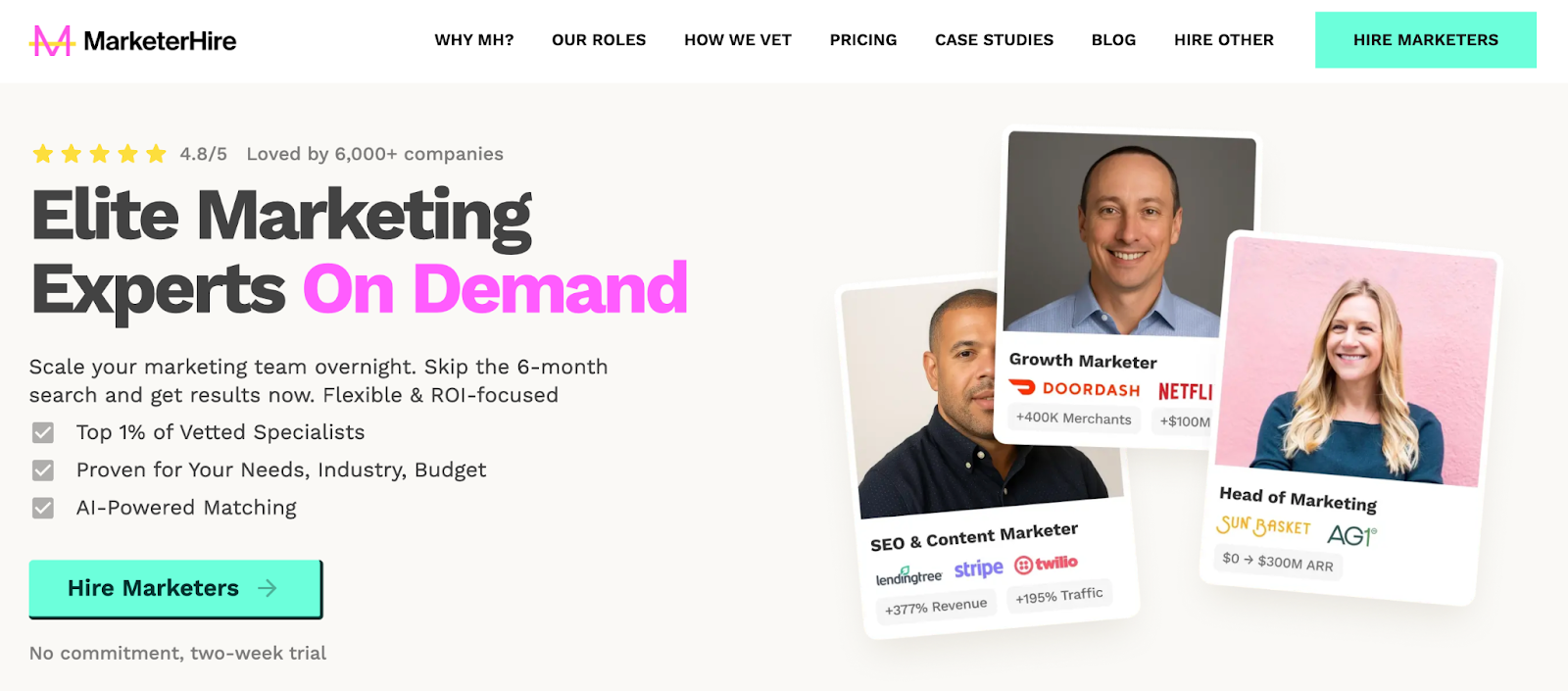
If you’re thinking MarketerHire isn’t an agency, you’d be 100% correct.
But we offer something better: direct access to a curated network of pre-vetted, senior-level marketers, including GTM specialists who have launched products, entered new markets, and scaled acquisition for leading brands. These are experts from companies like Stripe, Twilio, Quip, WPP, and Spanx—people with proven playbooks who have already solved the exact challenges you’re facing.
Once you tell us your hiring needs, we use a combination of AI-powered matching and human expertise to connect you with the right marketer for your industry, growth stage, tech stack, and business objectives, often within 48 hours. You meet them for free, confirm the fit, and start with a two-week free trial at no risk. If it’s not a match, we replace them immediately, no questions asked.
MarketerHire is built for speed and flexibility. Whether you need a fractional GTM lead to refine your go-to-market strategy, a paid media expert to lower CAC, or an entire cross-functional team to manage sales enablement, content, and channel strategy, we can scale resources up or down as your needs change. All engagements are month-to-month, with zero termination fees and 30 days’ notice to cancel.
We’ve helped over 6,000 companies—from startups to Fortune 500s—move from guesswork to growth in as little as 14 days. With an acceptance rate under 1%, our marketers don’t need hand-holding; they integrate quickly with your internal processes and focus on hitting your goals from day one.
Best for: Founders, marketing leaders, and GTM teams who want senior-level expertise without the overhead of a traditional agency.
Past clients: Bloom Institute of Technology, Outer, Pinpoint, Swyftfilings Whole30
Pricing:
MarketerHire has three pricing tiers:
- Starter - $5,000+/month
- Growth - $10,000+/month
- Scale - $15,000+/month
2. inBeat
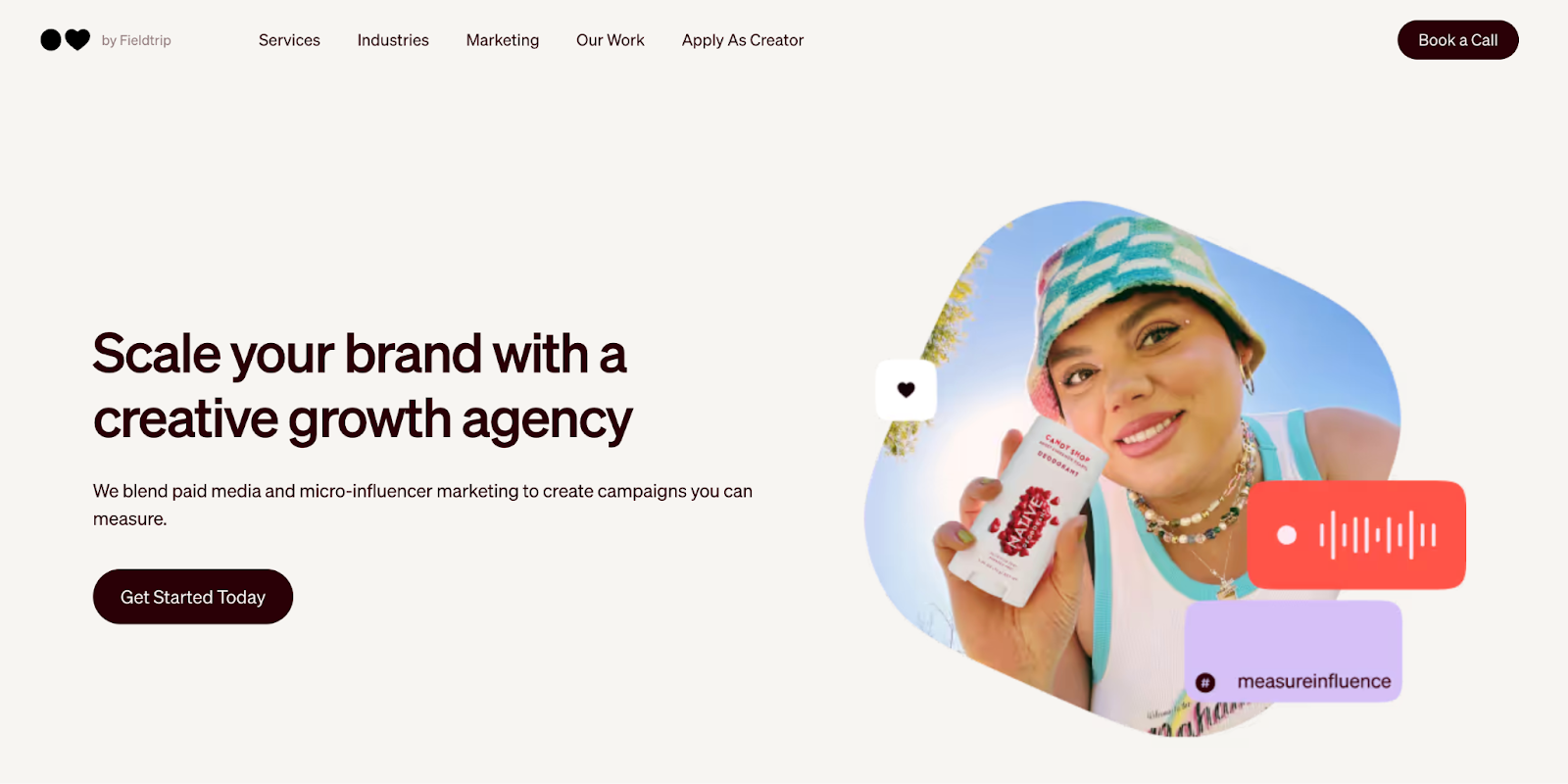
inBeat is a creative growth agency that fuses performance-driven creative with targeted influencer campaigns to help brands grow. Their creator-centric approach puts carefully selected macro and micro-influencers at the heart of every go-to-market strategy, ensuring brand alignment, audience relevance, and authentic engagement.
Leveraging data-driven insights, inBeat’s experts design campaigns tailored to each social platform—Facebook, Instagram, TikTok, LinkedIn, and beyond—to maximize performance and ROI.
As certified partners with TikTok, Meta, and Google, the agency delivers strategies backed by platform expertise and proven results for businesses of all sizes.
Best for: eCommerce, retail, and DTC brands looking to grow fast through social-first GTM strategies.
Industries served: Consumer packaged goods, mobile apps, direct-to-consumer, eCommerce, technology, healthcare
Services: Paid media, influencer marketing, UGC ads, static ads, creative strategy, touchpoint optimization
Past clients: 7-Eleven, Bumble, Disney, Hopper, Nordstrom
3. Ironpaper

Ironpaper helps B2B companies with long or complex sales cycles generate qualified leads, align marketing and sales, and achieve measurable revenue growth. They specialize in demand generation, Account-Based Marketing (ABM), content creation, and more, with a relentless focus on ROI over vanity metrics.
As a HubSpot Diamond Certified agency partner, Google Partner, and Databox Premier Certified agency partner, Ironpaper blends strategy, execution, and analytics to continuously improve marketing performance and clearly communicate each client’s value proposition to ideal buyers.
Best for: B2B companies that need a data-driven approach to lead generation, ABM, and marketing-sales alignment.
Industries served: B2B, SaaS, eCommerce, IoT (Internet of Things), finance, IT, technology, manufacturing, cybersecurity, energy, heavy industry, healthcare (B2B)
Services: Account-Based Marketing (ABM), lead generation, content marketing, digital marketing, web development
Past clients: Ambi Robotics, Goddard, Mobilewalla, Retarus, Crossfit eCommerce
4. Six & Flow

Six & Flow is a HubSpot Elite Partner agency that helps businesses plan, launch, and scale their go-to-market strategies using HubSpot as the central growth engine.
Their GTM approach involves aligning sales, marketing, and customer teams, structuring data for decision-making, and building integrated systems that accelerate pipeline velocity.
With expertise in RevOps, GTM technology, and AI integration, they design and execute campaigns that improve lead qualification, unify customer data, and enable measurable growth.
With over 1,000 successful projects under their belt, Six & Flow combines technical precision with strategic insight to ensure your HubSpot setup becomes a platform for GTM success.
Best for: B2B companies that want to use HubSpot to execute a scalable GTM strategy, unify revenue operations, and drive sustainable growth
Industries served: Software, professional services, recruitment, manufacturing, automotive, real estate, non-profit, B2B
Services: HubSpot implementation and training, AI & CRM enablement, sales enablement, demand generation, GTM optimization, data integrations
Past clients: AutoTrader, Canadian Red Cross, Markel, Smeg, University of Cambridge
5. Single Grain

Single Grain is a digital marketing agency that designs and executes custom GTM plans for businesses of all sizes. Their approach covers everything from channel strategy and paid media to conversion rate optimization (CRO), ensuring each step of the launch journey drives real traction.
With scalable, AI-driven solutions and a focus on proactive market positioning, Single Grain enables brands to market successfully in competitive industries and achieve lasting growth.
Best for: eCommerce and technology companies that need a multi-platform go-to-market strategy to launch a new product and capture market share.
Industries served: SaaS, eCommerce, education, crypto, and blockchain
Services: Paid advertising, performance creative, content marketing, email marketing, SEO, CRO
Past clients: Airbnb, Amazon, Crunchbase, Salesforce, Uber
6. Foundation Inc.

Foundation Inc. helps companies build and execute go-to-market strategies with content as the primary growth engine.
Their process starts with deep audience research—studying customer language, competitor positioning, and market signals—to uncover content-market fit. They then design a 12-month content engine that fuels awareness, pipeline, and conversions. The agency also handles content distribution across channels like LinkedIn, X, email, and SEO.
By auditing and optimizing existing content, they ensure every asset ranks higher, converts better, and stays aligned with brand excellence. Their approach blends data-backed insights, bold creatives, and a focus on scalable distribution to position clients as category leaders.
Best for: B2B companies that want to anchor their GTM plans in research-driven, conversion-focused content.
Industries served: B2B, software, GenAI, manufacturing, professional services, higher education
Services: GTM services, social media marketing, content marketing (creation, distribution, repurposing), paid search, CRO services, SEO, GEO
Past clients: Audiense, Canva, Mailchimp, Procore, Rockwell Automation
7. Ziggy

Ziggy specializes in helping B2B SaaS and enterprise tech companies create and roll out GTM plans that scale revenue while lowering CAC.
Their approach starts with identifying high-LTV customer segments, optimal deal sizes, and realistic growth targets, then building a customer acquisition engine designed for speed, predictability, and long-term growth.
Using the bow-tie model, Ziggy measures both acquisition (ARR) and retention (NRR), pinpointing bottlenecks across the revenue engine. Their tailored strategies reduce CAC by up to 40% (from previous clients), improve payback periods, and deliver sustainable, profitable unit economics.
Best for: Companies ready to scale revenue, lower CAC, and execute a high-impact GTM strategy for predictable growth.
Industries served: B2B, SaaS, finance, technology
Services: Go-to-market strategy, marketing automation, paid media strategy, revenue dashboarding, research and intelligence
Past clients: Antavo, Deel, Marqueta, Primer, Sabre
Read: How to Structure a Product Marketing Team in 2025
How to choose the right go-to-market agency
The wrong GTM agency can burn budget, stall momentum, and leave you scrambling to recover market share. But the right one will help you market successfully, hit your objectives, and set you up for long-term success.
Here’s what to look for (and what to ask) before you sign.
1. Define your launch KPIs before you start.
Before meeting with a market agency, clarify internally what success looks like for your launch. This could mean hitting a certain number of MQLs (marketing-qualified leads), achieving early revenue targets, lowering CAC (customer acquisition cost), or capturing a set percentage of target customers in your first quarter.
Clear KPIs (key performance indicators) allow you to measure measurable results and avoid falling for vanity metrics. They also help your chosen partner design a go-to-market strategy that directly supports business growth and sustainable growth.
Internal questions to ask:
- What specific metrics will define a successful launch for us?
- How will these metrics support our overall business goals?
- What’s our baseline for these metrics today?
2. Ask for relevant launch case studies.
A proven track record is more valuable than any sales pitch. Ask the agency for case studies from new markets or industries similar to yours, showing how they’ve achieved successful market entry and growth.
The best case studies won’t show only the end results—they’ll also explain the strategy development process, channels used, and how the agency adapted to market dynamics and competitive landscape.
Questions to ask the agency:
- Can you share case studies from launches similar to ours?
- How did you adjust a GTM strategy you built when challenges came up?
- What metrics did you track, and how did they improve over time?
3. Look for alignment on your unique value proposition.
An agency that understands and can articulate your UVP will give you a competitive edge in a crowded market. If they can’t explain what sets you apart from your customers in a way that prospective customers will understand, they’ll struggle to position you effectively.
Questions to ask the agency:
- How would you describe our value proposition to a cold audience?
- How do you test messaging to ensure it resonates with the right audience?
- How would you adapt messaging for new audiences or new service offerings?
4. Check execution model: marketing-led, sales-led, hybrid, or product-led.
Different products require different launch approaches. For example, the launch of a SaaS platform might be spearheaded by the sales team, while a consumer app might rely on influencer marketing and organic reach.
Ask how the agency decides between marketing-led, sales-led, product-led, or hybrid execution, and how they adapt if market response changes.
Questions to ask the agency:
- Which execution model do you recommend for our product and why?
- How do you integrate sales enablement with marketing efforts?
- How quickly can you pivot your go-to-market strategies if needed?
5. Evaluate measurement and optimization processes.
A good GTM partner focuses on metrics like CAC, customer lifetime value (CLV or CLTV), churn rate, conversion rates, and sales cycle length. They should be prepared for continuous optimization, using data-driven insights to improve conversions, get customers, and boost brand loyalty.
Questions to ask the agency:
- What KPIs do you typically track for a go-to-market launch?
- How often do you review and optimize based on results?
- Can you share an example of when optimization significantly improved results?
6. Assess team structure and contract terms.
When you hire GTM agency, you’re bringing in a team that needs to mesh with your internal processes and work toward shared company objectives. Ask who will be working on your account, how communication will be handled, and whether you have flexibility in scope and duration.
Questions to ask the agency:
- Who will be directly responsible for execution and reporting?
- How do you ensure timely service delivery during a launch?
- Can we adjust the scope mid-project if priorities shift?
Read: What Does a Product Marketing Manager Do? Ultimate PMM Guide 2025
Measuring go-to-market agency success
Hiring an agency is only half the equation; proving it’s driving growth is the other half. Here are five ways to do that:
1. Track early traction metrics.
In the first 30–90 days, your agency should be delivering signs of market momentum. Key metrics include:
- Lead flow – Is the volume of qualified leads increasing week over week?
- Pipeline velocity – Are deals moving faster through your funnel, thanks to better messaging or sales enablement?
- Conversion improvement – Are you closing a higher percentage of opportunities? For example, if your average conversion rate was 12% before launch and is now 18%, that’s a clear win.
To track these metrics, set a baseline for each metric before launch. Then track weekly using your CRM or analytics platform. Look for steady upward trends, not just one-off spikes. Tie improvements back to specific GTM strategies or campaigns the agency implemented.
2. Measure content traction and engagement.
If your GTM partner is running digital marketing or influencer marketing campaigns, don’t just look at clicks—measure engagement quality. For example:
- Internal linking performance – Track whether readers click through to product pages or landing pages from blog posts/articles.
- Scroll depth & time on page – Are visitors consuming full articles, case studies, or product explainers from start to finish?
- Content-assisted conversions – Did a prospect view your content before requesting a demo or making a purchase?
To measure content engagement, set up tracking in Google Analytics or your marketing automation platform. Create goals for specific channels and attribute conversions back to them. This shows whether your agency’s messaging is succeeding at nudging target customers toward action.
3. Benchmark and review regularly.
Your agency should be reviewing results with you on a set cadence, e.g., weekly during launch, then monthly post-launch. The review should:
- Compare results against agreed KPIs.
- Highlight what’s driving wins and what needs adjustment.
- Recommend continuous optimization steps based on data-driven insights.
You and the agency should agree on a reporting format up front. It could be a dashboard showing conversion rates, CAC, market share growth, and brand loyalty metrics. Make sure every number connects back to a business goal so you’re measuring outcomes, not just activity.
4. Monitor strategic impact over time.
If your GTM partner executed your go-to-market strategy well, you should see their work influencing market dynamics and positioning over the next 6–12 months. Signs include:
- Gaining a competitive advantage in a crowded market.
- Attracting new audiences and potential customers.
- Increasing paid conversions, product adoption, and customer retention rates.
To do this, run quarterly market research or customer surveys. Track shifts in brand awareness, share of voice, and customer satisfaction, and compare your results against your competitors to see if your go-to-market strategy is keeping pace.
5. Tie activity to revenue outcomes.
Ultimately, success means hitting revenue and growth targets. Whether it’s account-based marketing for enterprise deals or broad lead generation for consumer products, you need to tie agency activities directly to booked revenue.
Do this by using attribution modeling in your CRM to connect campaign touchpoints to closed deals. For example, if a piece of thought leadership content generated 20 demo requests and 5 sales, calculate the revenue impact.
This shows you whether or not your go-to-market spend is generating measurable results.
Read: 5 Signs You Need a Growth Marketing Manager
Go-to-market agency vs. freelancer vs. on-demand talent
If you’re not sure if you should hire an agency, a freelance GTM expert, or a dedicated GTM specialist (via MarketerHire), here’s a table showing how the three models compare:
When to choose MarketerHire over a go-to-market agency
Sometimes speed, flexibility, and precision matter more than hiring a full-service agency. MarketerHire’s GTM experts give you industry expertise on demand without long contracts or the overhead of traditional agencies.
Here’s when hiring a GTM specialist from MarketerHire is the smarter move:
- Launching a product quickly – If you have a tight launch window, waiting weeks for an agency onboarding process can cost you market share. MarketerHire can match you with a GTM expert in under 48 hours, so you can get started building and executing a GTM strategy.
- Testing a new market or channel – Expanding into new markets or experimenting with a fresh marketing channel requires a focused, low-risk approach. With on-demand talent, you can run tests, gather insights, and adjust your strategies without committing to an expensive long-term contract.
- Repairing underperforming GTM efforts – If your current campaigns aren’t driving measurable results, a vetted specialist can audit your go-to-market strategy development, refine your value proposition, and reexecute to capture the right audience.
- Needing GTM senior support fast – When you require leadership-level strategic planning, a MarketerHire specialist can step in to guide your team and combine expertise across functions to deliver good outcomes.
- Finding someone who fits your existing stack – If your workflows, tools, and internal processes are already set, a dedicated expert can slot right in without you having to overhaul how your team operates.
Read: 10 Best Product Marketing Agencies in 2025
Choosing the right GTM partner
Launching into a competitive market without the right execution partner is a gamble. The right GTM support doesn’t just get you to launch—it helps you capture the right audience, scale efficiently, and create momentum you can sustain. Whether that comes from a full-service agency or an embedded specialist, the goal is the same: predictable, measurable growth.
If you need senior-level GTM expertise without the overhead of a traditional agency, MarketerHire can match you with a pre-vetted GTM specialist in under 48 hours. Whether you’re launching fast, testing new markets, or fixing underperforming campaigns, you’ll get a proven expert who integrates seamlessly with your team and drives results from day one.
Book your free consult and get matched with a GTM expert today.
